

[May 27, 2026] InsuranceSuite-Developer Exam Dumps - Try Best InsuranceSuite-Developer Exam Questions - PracticeMaterial
Verified InsuranceSuite-Developer exam dumps Q&As with Correct 79 Questions and Answers
NEW QUESTION # 31
An insurer specializing in high-risk policies requires a new Account to provide at least three references. A Reference entity is created. What is the best practice for adding and displaying References on the Contact Summary page in TrainingApp?
- A. Create a Contacts pop up and add a button that opens it to the Contact Summary page
- B. Create an input set that displays References and add it to the Contact Summary page
- C. Create a Reference detail view with fields for three References and add it to the Contact Summary page
- D. Create a Reference list view and add it to the Contact Summary page
Answer: D
Explanation:
In Guidewire PCF (Page Configuration Framework) development, the selection of the correct widget is driven by the underlying data relationship. In this scenario, a "Reference" is a separate entity, and an Account (or Contact) is likely to have multiple instances of these references (a one-to-many relationship). According to Guidewire best practices, when you need to display a collection of objects-especially when that collection can vary in size or requires the user to see multiple entries at once-theList View (LV)is the standard and most efficient UI component.
AList Viewprovides a tabular format that allows users to view, sort, and sometimes edit multiple records simultaneously. By creating a ReferenceLV.pcf and embedding it into the ContactSummary.pcf (typically via a PanelRef), the developer provides a clean, scalable interface. This approach is superior to aDetail View (DV)because a DV is designed for a single record's specific fields; attempting to hard-code "three references" into a DV (Option A) is fragile and non-scalable if the business requirement later changes to four or five references.
Furthermore, embedding the List View directly on the Summary page ensures that the information is immediately visible to the user ("at a glance"), which aligns with the purpose of a "Summary" page. Using a Popup(Option B) adds unnecessary clicks to the user workflow, and anInput Set(Option D) is generally intended for grouping related input fields within a Detail View rather than managing a collection of entity instances. By utilizing the List View, the developer follows the architectural pattern of "Master-Detail" or
"List-Detail" commonly found throughout the InsuranceSuite applications, ensuring the UI remains consistent with the rest of the Guidewire platform.
NEW QUESTION # 32
The Officials list view in ClaimCenter displays information about an official called to the scene of a loss (for example, police, fire department, ambulance). The base product captures and displays only three fields for officials. An insurer has added additional fields but still only displays three fields. The insurer has requested a way to edit a single record in the list view to view and edit all of the officials fields. Which location type can be used to satisfy this requirement?
- A. Location group
- B. Forward
- C. Page
- D. Popup
Answer: D
Explanation:
In Guidewire InsuranceSuite UI design, balancing information density is a common challenge.List Views (LVs)are optimized for showing multiple records at once but are limited by horizontal screen real estate.
When an entity has more fields than can comfortably fit in a table-as is the case with the expanded
"Officials" entity-Guidewire best practices recommend using aPopup(Option C) for detailed editing.
A Popup is a specializedLocationtype that opens a secondary window over the current page. This allows the developer to embed a fullDetail View (DV)containing all the new fields (police badge numbers, department contact info, etc.) without navigating the user away from the main Claim screen. This "List-Detail" pattern is typically implemented by making one of the fields in the List View (like the Official's name) aLinkor by adding an "Edit" button that calls the popover or push method to launch the Popup.
Other location types are inappropriate for this specific requirement. AForward(Option A) is a non-visual location used for logical branching (deciding where to send a user based on data). APage(Option B) would take the user completely away from the current context, which is disruptive for a simple edit. ALocation Group(Option D) is used for structural navigation in the sidebar, not for individual record interaction. By utilizing a Popup, the developer provides a focused, high-density editing environment that maintains the user's workflow within the ClaimCenter application.
NEW QUESTION # 33
An insurer ran the DBCC checks against a copy of their production database and found three errors with high counts in the categoryData update and reconciliation. What are two best practices for resolving the errors?
(Select two)
- A. Identify any bad data and write a SQL script to correct the data; run the script immediately
- B. Analyze the errors to determine the root cause and correct the code responsible for the errors
- C. Wait to see if error counts increase; if they increase by more than 10%, fix the errors
- D. Search the Knowledge Base on the Guidewire Community for solutions to the problems found
- E. Promote the code to production and run the DBCCs again
Answer: B,D
Explanation:
Database Consistency Checks (DBCCs) are the "canary in the coal mine" for data integrity. When high error counts appear in theData update and reconciliationcategory, it usually implies that recent configuration changes (Gosu rules, enhancements, or batch processes) are generating data that violates the underlying metadata constraints.
The first best practice isRoot Cause Analysis(Option A). Simply fixing the data in the database is a "band- aid" solution; if the underlying Gosu code that created the bad data is not fixed, the errors will immediately return. Developers must trace the lifecycle of the affected entities to find where the logic is failing.
The second best practice is to leverage theGuidewire Community Knowledge Base(Option E). Many DBCC errors, especially those following a version upgrade or a major configuration change, have been encountered by other insurers. The Knowledge Base often provides specific SQL patterns or Gosu fixes tailored to known platform behaviors.
Why other options are incorrect:
* Option Bis dangerous; never promote code known to cause database inconsistencies to a production environment.
* Option Cis irresponsible; data corruption should be addressed as soon as it is detected.
* Option Dis a partial fix, but "running the script immediately" without a code fix or support review (as discussed in Question 61) is high-risk and violates Cloud Assurance standards.
NEW QUESTION # 34
When viewing application logs in Datadog for troubleshooting, which methods can be used to find specific information within the logs, according to the training? Select Two
- A. Using the search bar for full-text searches.
- B. Using the sidebar facets to filter results
- C. By examining the build history in TeamCity.
- D. Creating custom dashboards with relevant widgets.
- E. Using the Monitors section to set up alerts.
- F. By querying the Lifecycle Manager API.
Answer: A,B
Explanation:
In the Guidewire Cloud Platform (GWCP) ecosystem,Observabilityis primarily handled through the integration withDatadog. Developers use Datadog to monitor the health of their "Planets" and to perform deep-dive troubleshooting of application logs. Navigating through millions of log lines requires efficient filtering and searching techniques.
The two primary methods taught in the "Developing with Guidewire Cloud" course for finding specific log entries aresidebar facetsand thesearch bar.Sidebar facets(Option D) are structured filters based on log metadata. In a Guidewire context, these facets allow a developer to quickly narrow down logs by specific criteria such as the "Planet" (Dev, Pre-prod), the specific "Service" (ClaimCenter, BillingCenter), the "Log Level" (Error, Warn), or even a specific "Trace ID." This structured approach is essential for isolating errors to a specific environment or time window.
Complementing this is thesearch bar for full-text searches(Option F). This allows developers to search for specific strings within the log message itself-such as a specific Claim Number, a unique Exception class name, or a custom log prefix defined in Gosu code. By combining full-text search with facet filtering, developers can rapidly pinpoint the exact root cause of a production or development issue.
Other options are related to the cloud ecosystem but do not serve the specific purpose offinding information within logs. TeamCity (Option C) is for builds, not log analysis; and while Monitors (Option B) and Dashboards (Option E) provide higher-level views or alerts, they are not the primary tools for searching through the raw log data during an active troubleshooting session.
NEW QUESTION # 35
A business analyst has a new requirement for an additional filter on Desktop Activities. Which two options can be used to filter a query-backed ListView? (Select two)
- A. Use a Gosu standard bean filter in the filter property of a ToolbarFilterOption
- B. Create an array of filtered values to populate the ListView
- C. Use a Gosu standard query filter in the filter property of a ToolbarFilterOption of a ToolbarFilter widget
- D. Add a ToolbarFilterOption to the ToolbarFilter widget
- E. Create a Gosu method to loop through the ListView rows adding the rows that match the criteria
Answer: C,D
Explanation:
In Guidewire PCF development, filtering aquery-backed ListView(one that uses a QueryProcessor) must be done efficiently to avoid loading thousands of records into memory. According to theInsuranceSuite Developer Fundamentalscourse, the standard tool for this is theToolbarFilterwidget.
AToolbarFilteracts as a container for one or moreToolbarFilterOptionwidgets (Option C). Each option represents a choice in the dropdown menu for the user. To ensure performance, specifically for query-backed lists, the developer should use aGosu standard query filter(Option B) in the filter property. Unlike a "bean filter," which filters objects already in memory, a query filter allows the Guidewire platform to modify the underlying SQL statement. This ensures that only the records matching the selected filter are ever retrieved from the database, significantly reducing the application server's load.
Options D and E are "anti-patterns." Manual looping or creating custom arrays bypasses the optimized Query API, leading to "OutOfMemory" errors or severe performance degradation when dealing with large volumes of data, such as an insurer's entire set of desktop activities.
NEW QUESTION # 36
Which log message follows logging best practices in production?
- A. The claim was created successfully for: Ray Newton, email: [email protected], vehicle: white 2022 Toyota Camry.
- B. ERROR! The claim was not created because the database connection was lost.
- C. The personal auto claim was created for Jane Smith with driver's license AD45678.
- D. [Method=ClaimProcess#createClaim][Claim#PublicID=00001234] was created.
Answer: D
Explanation:
In theGuidewire InsuranceSuite Developer Fundamentalscourse, logging best practices are strictly tied to two primary concerns:Security (PII protection)andTroubleshooting Efficiency.
Option A is the correct choice because it providescontextual, structured datawithout revealing sensitive information. It includes the method name (createClaim) and the unique database identifier (PublicID). Using the PublicID is the gold standard in Guidewire development because it allows developers to look up the exact record in the database or the UI without loggingPersonally Identifiable Information (PII). This ensures compliance with data privacy regulations like GDPR and CCPA.
In contrast, Options B and C are significant security violations. Option B logs a name and a driver's license number, while Option C logs a name, email address, and vehicle details. These are all considered PII and should never appear in clear text in application logs. Option D is poor practice because it is "noisy" and lacks specific context (like a claim number or timestamp) that would help a developer determinewhichattempt failed, and the use of "ERROR!" with an exclamation mark is non-standard for system logs. Structured logging, as seen in Option A, allows automated tools like Datadog to parse the logs more effectively.
NEW QUESTION # 37
In TrainingApp. the Person Info card of the Details screen for a contact has a section where basic employment information is stored: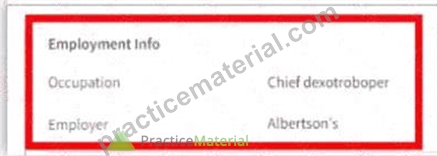
The insurer requires this information to be displayed, in this format, on every card of both the Summary and Details screens, for every individual person contact. This information will be stored in a container to be reused on all these cards.
Which object will most efficiently meet this requirement, according to best practices?
- A. Worksheet PCF file
- B. Input set widget
- C. Input Set PCF file
- D. Detail View Panel
Answer: C
Explanation:
In Guidewire InsuranceSuite development, the Page Configuration Framework (PCF) is designed around the principles of modularity and reusability. When a business requirement specifies that a group of fields-such as basic employment information-must appear identically across multiple screens (e.g., Summary and Details), the most efficient approach is to create a reusable component. According to theInsuranceSuite Developer Fundamentalscourse, theInput Set PCF file(Option C) is the standard object for achieving this.
AnInput Set PCF fileis a standalone metadata file that contains a collection of input widgets (like TextInput, DateInput, etc.). By defining the employment fields in a single Input Set file, you create a "source of truth." To display these fields on different screens, a developer simply adds anInputSetRefwidget to the target Detail View or Page and points it to the employment Input Set file. This architectural pattern ensures that if the business later decides to add a "Work Phone" or "Employee ID" field, the developer only needs to update one file. This update then automatically reflects across all screens where the Input Set is referenced, significantly reducing maintenance effort and the risk of UI inconsistency.
Other options are less suitable for this specific task. ADetail View Panel(Option A) is a higher-level container; while it can be reused, it is generally intended to hold larger sections of a page and may contain logic that isn't applicable to every card. AnInput set widget(Option B) is merely a structural element within a single PCF file and does not provide cross-file reusability on its own. AWorksheet(Option D) is a UI element that slides up from the bottom of the application window and is not intended to be embedded directly into the layout of a Summary or Details card. Therefore, the Input Set PCF file is the most granular and effective tool for field-level reuse.
NEW QUESTION # 38
Which logging statement follows best practice?
- A. If(_logger.DebugEnabled) { _logger.debug(logPrefix + someReallyExpensiveOperation()) }
- B. _logger.error(DisplayKey.get("Web.ContactManager.Error.GeneralException", e.Message))
- C. If(_logger.InfoEnabled) { _logger.debug("Adding '${contact.PublicID}' to ContactManager") }
- D. _logger.info(logPrefix + "[Address#AddressLine1=" + address.AddressLine1 + "] [Address#City" + address.City + "] [Address#State" + address.State + "]")
Answer: A
Explanation:
Logging efficiency is a critical component of Guidewire application performance. In a production environment, logging levels are typically set to INFO or WARN. However, developers often include DEBUG level logs to assist with troubleshooting. The primary performance risk occurs when a log statement requires significant computational resources to construct the message string-such as calling a method that performs complex calculations or database lookups-even when the log level is currently disabled.
Option C follows the absolute best practice by wrapping the log call in anIsDebugEnabledcheck. This ensures that the someReallyExpensiveOperation() method is only executed if the system is actually configured to record debug logs. Without this check, the application would waste CPU cycles performing the
"expensive operation" only to have the logger discard the resulting string because the level was set to INFO.
Other options fail for various reasons: Option A incorrectly checks InfoEnabled before calling debug, which is a logical mismatch. Option B is risky because passing raw exception messages (e.Message) into a display key can lead to inconsistent formatting or potential security issues if the message is shown to users. Option D demonstrates "Chatty Logging" and string concatenation without a level check, which can negatively impact performance and clutter log files with non-essential state data. Guidewire's logging framework (built on Log4J
/SLF4J principles) thrives when developers use guards like DebugEnabled to protect system resources.
NEW QUESTION # 39
The Marketing department wants to add information for attorneys and doctors; For doctors, store the name of their medical school. For attorneys, store the name of their law school.
Which two data model extensions follow best practices to fulfill this requirement? (Select two)
- A. A varchar column on ABAttorney, named LawSchooLExt
- B. An array on ABPerson. named ProfessionalSchools_Ext
- C. A varchar column on ABDoctor, named MedSchool_Ext
- D. An entity named ProfessionalSchooLExt. storing the school's name and type
- E. An entity named MedSchooLExt and a foreign key to it from AB_Doctor
- F. An entity named LawSchooLExt. and a foreign key to it from AB.Attorney
Answer: A,C
Explanation:
When extending the Guidewire Data Model, developers must choose the most efficient storage mechanism based on the nature of the data and its relationship to existing entities. In this scenario, the requirement is to store a single piece of information-a school name-for two specific subtypes of person contacts: Doctors and Attorneys.
According to Guidewire best practices for Entity Extensions, if a piece of data has a one-to-one relationship with an entity and is a simple data type (like a String/Varchar), it should be added directly to the entity extension file (.etx) as a column. Options B and C follow this principle. By adding MedSchool_Ext to the ABDoctor entity and LawSchool_Ext to the ABAttorney entity, the developer ensures that the data is stored in the specific table where it is relevant. This avoids unnecessary complexity in the database schema and simplifies UI configuration, as the fields can be accessed directly from the object without traversing a foreign key or array.
Alternatives like creating separate entities for the school names (Options A, D, and F) or using an array on the base person entity (Option E) represent "over-engineering." Creating a separate entity and a foreign key is only recommended if the data needs to be normalized (e.g., if multiple people share the exact same school record and that record has its own attributes like address or accreditation). In the context of a Marketing request to simply capture a name, adding a varchar column with the mandatory _Ext suffix is the most performant and maintainable approach. It keeps the database joins to a minimum and follows the Guidewire
"KISS" (Keep It Simple, Stupid) principle for configuration.
NEW QUESTION # 40
A developer is creating an entity for home inspections that contains a field for the inspection date. Which configuration of the file name and the field name fulfills the requirement and follows best practices?
- A. HomeInspection_Ext.etx, InspectionDate
- B. HomeInspection.Ext.eti, InspectionDate
- C. HomeInspection_Ext.eti, InspectionDate.Ext
- D. HomeInspection.eti, InspectionDate.Ext
- E. HomeInspection.etx, InspectionDate.Ext
Answer: C
Explanation:
Guidewire'sMetadata Naming Conventionsare strictly enforced to ensure that customer code remains distinct from Guidewire's base product code, which is essential for seamless platform upgrades.
When creating abrand-new entity, the developer must use the.eti (Entity Interface)extension. Following Cloud Delivery Standards, the entity name itself must include the_Extsuffix. Therefore, HomeInspection_Ext.
eti is the correct file structure. Regarding the fieldswithinthat custom entity, Guidewire best practices recommend applying the_Extsuffix to custom columns as well (Option B), even if the entity itself is custom.
This provides a consistent visual indicator in Gosu code that the developer is interacting with an extension rather than a base product element.
Option A and C use the .etx extension, which is reserved forextending existing base entities(e.g., adding a field to Claim). Option D is incorrect because it lacks the mandatory suffix on the entity name. Option E uses an invalid file naming format. Following the convention in Option B ensures the data model is compliant with Guidewire's automated quality gates.
NEW QUESTION # 41
There is a requirement to add fields specific to Auto Rental Agencies. The additional fields required are; Auto Renta License, Offers Roadside Assistance, and Offers Insurance. Other fields will come from the existing ABCompanyVendor entity.
For reference, the diagram below shows the ABCompany subtype of the ABContact entity: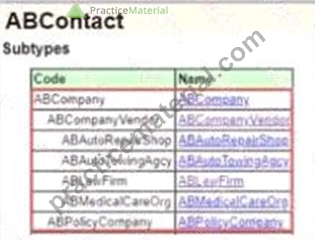
How should this requirement be configured following best practices?
- A. Create three new fields to extend the existing ABCompany Vendor subtype
- B. Create ABAutoRentalAgency.Ext as a subtype of A B Company Vendor and add the three fields to the subtype
- C. Create a custom entity ABAutoRentalAgency_Ext and add the three fields to this entity
- D. Create ABAutoRentalAgency.Ext as a subtype of ABCompany and add the three fields to the subtype
Answer: B
Explanation:
In the Guidewire Data Model, managing entity relationships through Subtyping is a core principle for maintaining a clean, performant, and logically structured database. According to the InsuranceSuite Developer Fundamentals course, subtyping should be used when a specific group of entities shares a common base but requires additional, unique attributes.
1. Leveraging the Existing Hierarchy
The prompt specifies that "other fields will come from the existing ABCompanyVendor entity." In the Guidewire ContactManager (AB) data model, the hierarchy typically flows from ABContact # ABCompany # ABCompanyVendor. By creating ABAutoRentalAgency_Ext as a subtype of ABCompanyVendor (Option A), the new entity automatically inherits all properties from the vendor level (such as Tax ID or Vendor Number) and the company level (such as Name or Address). This maximizes code and metadata reuse.
2. Why Subtyping is Better than Extension
If a developer were to follow Option D and add these three fields directly to ABCompanyVendor, every vendor in the system-including Law Firms, Doctors, and Repair Shops-would have fields for "Auto Rental License." This is known as "data model pollution." It makes the database tables wider than necessary and complicates the UI, as you would need complex "visible" expressions to hide these irrelevant fields for other vendor types.
By creating a specific subtype, Guidewire's Table-per-Subtype or Table-per-Hierarchy (depending on version and configuration) storage strategy ensures that these three specific fields are only relevant to Auto Rental Agency records. This keeps the data model logically distinct and allows for the use of Modal PCFs, where the UI automatically switches to display the correct fields based on the subtype of the contact being viewed.
Best Practice Summary: Use the _Ext suffix for the new subtype to follow Cloud Delivery Standards and place it as deep in the existing hierarchy as possible to inherit the most relevant specialized fields.
NEW QUESTION # 42
Which statements describe best practices when using bundles in Gosu to save new entities/edit existing entities? (Select Two)
- A. Add all entities to the bundle, not just those which will be edited.
- B. Explicitly call the commit() method on the bundle outside of a managed block.
- C. Obtain a bundle using gw.transaction.Transaction.getCurrent().
- D. Create a new bundle using gw.transaction.Transaction.runWithNewBundle().
- E. Commit changes individually for each entity.
- F. Never call commit() within a runWithNewBundle() statement.
Answer: D,F
Explanation:
Managing transactions in Guidewire requires a deep understanding ofBundles. The modern and safest way to handle a transaction is using the runWithNewBundle(\ bundle -> { ... }) block (Option B).
When using runWithNewBundle, the Guidewire platform automatically handles the "Plumbing" of the transaction. It opens the bundle, provides a safe execution context, andautomatically commitsthe changes when the block reaches the end. Therefore, a critical best practice is tonever call commit() manuallyinside that block (Option F). Doing so can interfere with the platform's error-handling and post-commit logic. Option E is used for UI-bound bundles (like those in a PCF), but for background logic or integration, a fresh, managed bundle via runWithNewBundle is the gold standard for avoiding data leakage or accidental modifications.
NEW QUESTION # 43
As a developer you are creating a new Gosu class for Succeed Insurance. According to the course material, which of the following statements define how you should implement logging in your new class? (Choose Two)
- A. Checking the log level before logging is usually unnecessary, as logging typically has minimal impact on performance.
- B. When logging at the debug level you should check to see if debugging in enabled first to minimize possible performance issues.
- C. When logging Personal Identifiable Information (Pll), developers should log the information at least at the INFO level.
- D. All exceptions are errors, thus they should always be logged at the error level.
- E. When logging an exception, provide details about the cause of the exception. Because you are providing a detailed description there is no need to log the exception message or stack trace.
- F. Logging in the cloud can be provided in either a string format or JSON.
- G. Providing context when logging errors is essential. However, developers should avoid excessive logging, as it can be costly to implement and maintain, and it may negatively impact performance.
Answer: B,G
Explanation:
In Guidewire development, logging is a critical tool for troubleshooting and monitoring, but it must be implemented with a focus on system performance and security. According to the Guidewire InsuranceSuite Developer guidelines, "excessive logging" is a common source of performance degradation. Developers are instructed to provide meaningful context for errors so that support teams can diagnose issues without needing to reproduce them manually. However, logging should be used judiciously; logging too much data (Option D) increases I/O overhead and can clutter logs, making it difficult to find relevant information.
A specific best practice highlighted in the course material involves the use of theDebuglog level. Because debug messages often involve complex string concatenation or data retrieval that consumes CPU cycles, developers should wrap these calls in a conditional check. By using if (logger.isDebugEnabled()) (Option C), the system avoids the cost of constructing the log message entirely if the current logging level is set to a higher priority, such as INFO or WARN. This practice is essential for maintaining high throughput in a production environment where debug logging is typically disabled.
Other options provided are contrary to Guidewire standards. For instance,Personal Identifiable Information (PII)(Option F) shouldneverbe logged in plain text due to data privacy regulations (GDPR/CCPA), and logging it at an INFO level would be a major security violation. Furthermore, while exceptions should be logged, not all exceptions are errors (some are expected business logic flows), and when they are logged, the stack trace is vital for debugging (refuting Option B). Guidewire Cloud primarily standardizes on structured logging (JSON) for observability, but the fundamental developer best practices regarding performance (C and D) remain the primary focus of the Fundamentals course.
NEW QUESTION # 44
The sources describe different types of deployment strategies for InsuranceSuite applications. What are characteristics of a selective deployment?
- A. It allows deployment of only the selected InsuranceSuite applications.
- B. It always involves a database restore from production.
- C. It requires deploying all InsuranceSuite and EnterpriseEngage applications simultaneously.
- D. It is the only strategy that supports rolling updates.
- E. It is primarily used for deploying builds to production star systems.
Answer: A
Explanation:
InGuidewire Cloud Platform (GWCP), deployment flexibility is key to managing complex multi- application environments. ASelective Deployment(Option E) is a strategy where a developer or release manager chooses to deploy a subset of the available applications rather than the entire suite.
For example, if a developer has only made configuration changes toPolicyCenterandContactManager, they can trigger a selective deployment for just those two applications while leavingClaimCenterandBillingCenter at their current versions. This is particularly useful in non-production environments (like Dev or QA) to speed up the build-and-deploy cycle and minimize disruption to other teams working on different applications.
Key characteristics include:
* Granular Control:You choose which specific components (e.g., PC, BC, CC, or Digital applications) are pushed.
* Environment Stability:It reduces the risk of side effects on applications that haven't changed.
* Pipeline Efficiency:Since fewer containers are being built and restarted, the overall deployment time is often shorter than a full suite deployment.
Option C describes the opposite (a Full Deployment). Option A is incorrect as production deployments typically follow a more rigid, all-inclusive "Release" structure to ensure synchronization. Option B is a data management task (masking/refreshing), which is distinct from the deployment of application code.
NEW QUESTION # 45
Given this function:
Code snippet
929 public function checkConnection() {
930 try
931 {
932 var conn = DriverManager.getConnection(url)
933 // logic here
934 }
935 catch (e : Exception)
936 {
937 // handle exception
938 }
939 }
What action will align the function with Gosu best practices?
- A. In line 933, change DriverManager to driver Manager (camel case)
- B. Add a comment for lines with significant code (specifically, lines 933 and 937)
- C. Move left curly braces on lines 931, 934, and 936 to the end of the previous lines
- D. Change line 935 to read 'catch {e: Exception)'
Answer: C
Explanation:
TheGuidewire InsuranceSuite Developer Fundamentalscourse emphasizes the importance of a consistent coding style to ensure that configuration code is readable and maintainable. This consistency is enforced through theGosu Style Guide, which dictates specific rules for formatting and indentation that all Guidewire developers should follow.
One of the most foundational rules in the Gosu Style Guide concerns the placement of curly braces ({). In Gosu, as in many modern programming languages derived from C-style syntax, there are two primary styles of brace placement: "Expanded" (where the brace is on its own line) and "K&R" or "1TBS" (where the brace is on the same line as the statement).Guidewire strictly adheres to the practice of placing the opening curly brace at the end of the linethat begins the block (the "1TBS" style).
Therefore, in the provided code snippet:
* The brace on line 931 should be moved to the end of line 930 (try {).
* The brace on line 936 should be moved to the end of line 935 (catch (e : Exception) {).
Adhering to this style is more than just a preference; it is a requirement for passingQuality Gatesin a Guidewire Cloud environment. When code is pushed to a repository in Guidewire Cloud, automated inspections check for these formatting issues. Code that fails these style checks may be flagged as technical debt or even prevent a successful build if strict quality gates are enabled. By moving the braces to the end of the previous lines (Option A), the developer ensures the code matches the visual pattern of the base Guidewire application, making it easier for other team members and Guidewire support to review and maintain the code over time.
NEW QUESTION # 46
Succeed Insurance needs to add a new getter property to the Java class generated from the Contact entity.
According to best practices, what steps below would allow this to get implemented? (Select Two)
- A. Add the enhancement definition to the Contact.eti file.
- B. Add a newget propertyto the enhancement.
- C. Add the enhancement definition to a new Contact.etx file.
- D. Add a new get function to the enhancement.
- E. Create a new Gosu enhancement for the Contact entity in the gw.entity.enhancements package.
- F. Create a new Gosu enhancement for the Contact entity in thesi.cc.entity.enhancementspackage.
Answer: B,F
Explanation:
In Guidewire development, you cannot directly modify the underlying Java classes generated from entities.
To add custom logic, properties, or methods to an existing entity like Contact, developers must useGosu Enhancements. This allows the extra functionality to be available on every instance of that entity throughout the application (Rules, PCFs, and other Gosu classes) without altering the base product files.
1. Package Naming Standards (Option E)
According to theInsuranceSuite Developer FundamentalsandCloud Delivery Standards, custom code must always be placed in a unique, customer-specific package. The gw package (Option C) is strictly reserved for Guidewire's internal code. Placing custom enhancements in a package like si.cc.entity.enhancements (where si stands for Succeed Insurance) ensures that the code is "upgrade-safe." During a platform upgrade, Guidewire replaces the gw packages but leaves the customer's custom packages untouched.
2. Properties vs. Functions (Option D)
The requirement specifically asks for a "getter property." In Gosu, this is implemented using theproperty get keyword. While you could technically write a function (e.g., getSomeValue()), a property allows for a cleaner syntax in other parts of the application. For example, if you define a property FullName_Ext, you can access it as myContact.FullName_Ext rather than myContact.getFullName_Ext(). This follows the Guidewire best practice of making the entity model feel like a cohesive, POJO-like structure.
Why other options are incorrect:
* Options A and B:.eti (Entity Interface) and .etx (Entity Extension) files are metadata files used to define thedatabase schema(columns, foreign keys, etc.). They are not used to write Gosu logic or enhancement definitions.
* Option F:While a "get function" is valid Gosu, the question specifically asks for a "getter property," which has a distinct syntax (property get) in the Guidewire framework.
By creating an enhancement in a customer-specific package and using the property syntax, the developer ensures the code is performant, readable, and follows the strict architectural guidelines required for Guidewire Cloud.
NEW QUESTION # 47
Which GUnit base class is used for tests that involve Gosu queries in PolicyCenter?
- A. SuiteDBTestClassBase
- B. PCUnitTestClassBase
- C. PCServerTestClassBase
- D. GUnitTestClassBase
Answer: C
Explanation:
In theGuidewire System Health & Qualitytraining, understanding the hierarchy of GUnit base classes is essential for writing effective automated tests.
While GUnitTestClassBase (Option A) provides basic testing functionality, it does not necessarily initialize the full application server environment or the database connection required for complex operations. For tests that require thefull Guidewire stack-including the ability to executeGosu queriesagainst the database or interact with the bundle-developers must usePCServerTestClassBase(Option D) in PolicyCenter (or CCServerTestClassBase in ClaimCenter).
This base class ensures that:
* The Guidewire Application Server environment is "mocked" or started.
* The current user session is authenticated.
* The database transaction manager (Bundles) is available for queries and commits.
Using a lower-level base class for a query-based test would result in a NullPointerException or a NoSessionException because the Query API requires an active server context to translate Gosu into SQL.
NEW QUESTION # 48
According to the training, which application in Guidewire Home is used to configure custom quality gates for pre-merge or pre-promotion stages within the GWCP pipeline? (Select Two)
- A. Storage Access
- B. Automated Builds
- C. Build Promotion
- D. Repository Settings
- E. Quality Gates
- F. CI/CD Manager
Answer: E,F
Explanation:
In theGuidewire Cloud Platform (GWCP), the management of the delivery pipeline is handled through Guidewire Home. To ensure that only code meeting the insurer's standards reaches higher environments, developers use two specific integrated applications.
TheCI/CD Manager(Option C) is the primary hub for managing the automation pipelines. It allows developers to define the flow of code from the repository to various environments (Dev, QA, UAT). Within this application, you configure the "stages" of the build.
To enforce specific standards at these stages, theQuality Gatesapplication (Option D) is used. Quality gates act as "toll booths" in the pipeline. They can be configured to check for specific criteria, such as a minimum percentage of GUnit test coverage, a lack of critical static analysis violations, or successful execution of performance smoke tests. If a build fails to meet the threshold set in the Quality Gates configuration, the CI
/CD Manager will automatically halt the promotion, preventing "bad code" from merging into the integration branch or moving to production.
NEW QUESTION # 49
Automated inspections help enforce quality by identifying anomalous code and adherence to defined metrics.
Which types of issues or rules are typically enforced by Guidewire Studio Inspections? Select Two
- A. Measurement of the Cyclomatic Complexity metric to ensure methods do not exceed 40 statements.
- B. Enforcement of naming standards for method and variable declarations across the entire Gosu configuration.
- C. Detection of memory leaks caused by large, long-running bundles that were not paged correctly during batch modification.
- D. Detection of unaccounted-for time (Own Time) during server round trips, indicating inefficient processing loops.
- E. Verification of data integrity to ensure that required columns on subtypes are correctly populated (a platform-level Database Consistency Check).
- F. Identification of potential programming bugs, such as empty if or else statements or unused loop variables.
Answer: B,F
Explanation:
Guidewire Studio Inspections are a form of static code analysis performed within the integrated development environment (IDE). These inspections analyze the Gosu source code and PCF files without actually executing the application. According to the "System Health & Quality" lesson, the primary goal of these inspections is to ensure code maintainability, readability, and the prevention of common logical errors.
One of the most critical roles of Studio Inspections is theenforcement of naming standards(Option B).
Guidewire has strict conventions for how classes, methods, and variables should be named (e.g., camelCase for variables, PascalCase for classes, and the use of the _Ext suffix for customer extensions). Inspections flag any deviations from these standards, ensuring that custom code blends seamlessly with the base product code.
This is vital for long-term maintenance and multi-developer collaboration.
Additionally, inspections are designed for theidentification of potential programming bugs(Option E). This includes detecting "code smells" such as empty if, else, or catch blocks, which often indicate incomplete logic or forgotten error handling. It also identifies unused variables, unreachable code, or potentially dangerous null pointer scenarios. By catching these issues at design-time, developers can resolve them before the code is even committed to the repository.
Other options refer to different tools: Option A describes theGuidewire Profiler(used at runtime), Option D describesDatabase Consistency Checks(DBCC), and Option F refers to memory monitoring and bundle management best practices that are generally outside the scope of basic static inspections. Studio Inspections focus specifically on the "health" of the source code itself.
NEW QUESTION # 50
Which of the following represents logging best practices? Select Two
- A. Set the logging level to "info" in the production environment.
- B. Log every transaction to ensure a complete audit trail.
- C. Set the logging level to "debug" in the production environment when diagnosing a production issue.
- D. Log all information that is necessary to diagnose the transaction.
- E. Mask personally identifiable information (PII) before including it in a log message.
Answer: D,E
Explanation:
Effective logging in Guidewire InsuranceSuite is a balance between providing enough information for troubleshooting and maintaining system security and performance. Two of the most critical best practices involveData PrivacyandDiagnostic Context.
First,Masking PII(Option A) is a non-negotiable requirement for modern insurance applications, especially those running on the Guidewire Cloud Platform. Personally Identifiable Information, such as social security numbers, credit card details, or even specific personal names and addresses, must never appear as clear text in the application logs. Logs are often aggregated into secondary systems (like Datadog or CloudWatch) and viewed by a wide range of support personnel. If PII is not masked or removed before logging, the company risks failing compliance audits (GDPR, HIPAA, etc.) and exposing sensitive data.
Second, developers should strive tolog all information necessary to diagnose the transaction(Option D).
This means providing context, such as a PublicID, a specific TransactionID, or the state of an object at the time of an error. Without this context, log entries like "Error processing claim" are useless for troubleshooting. The goal is to provide enough detail so that a developer can understand the failure path without needing to step through the code in a debugger.
Other options are incorrect because they represent poor operational or performance choices. Setting the level to "debug" in production (Option C) can lead to severe performance degradation due to high I/O. While "info" (Option B) is a common default, it is not a "best practice" in the same functional sense as security and diagnosis. Finally, "logging every transaction" (Option E) is not the purpose of application logs; audit trails should be handled via the system's built-inHistoryorEvent Messagingtables, not the text-based log files, to avoid overwhelming the storage and performance of the application.
NEW QUESTION # 51
The Cost entity contains the fields TotalPremium and Tax. The application needs to calculate the total cost as a sum of those two fields dynamically and wants to create a reusable solution. Which configuration is appropriate and efficient to achieve this task?
- A. Add a getter in CostEnhancement: property get TotalCost_Ext() : BigDecimal { return this.
TotalPremium + this.Tax } - B. Calculate the total cost in the value property in the PCF file.
- C. Create an entity enhancement and add: property set TotalCost_Ext(totalCost : BigDecimal){ totalCost = this.TotalPremium + this.Tax }
- D. Create an entity extension and add a new field to store the total cost.
Answer: A
Explanation:
In Guidewire development, the best practice for adding derived or calculated logic to an entity is using aGosu Enhancement. An enhancement allows you to add methods and properties to a base entity without modifying the underlying physical database schema or the original .eti file.
According to theInsuranceSuite Developer Fundamentalscourse, aread-only property (getter)is the most appropriate way to handle a dynamic calculation like "Total Cost." By defining a property get, the value is calculated on-the-fly whenever it is accessed. This ensures the data is always accurate and reflects the current state of TotalPremium and Tax without the risk of data desynchronization.
Option C is inefficient because adding a physical column to the database for a value that can be easily derived increases database size and requires complex logic to keep the "stored" total in sync with the source fields.
Option D is an anti-pattern; while calculating in a PCF works, it is notreusable-if you needed the total in a different page or a business rule, you would have to duplicate the logic. Option B is logically incorrect as a property set is used to assign values, not to return a calculated result.
NEW QUESTION # 52
An insurer would like to include the Law Firm Specialty as part of the Law Firm's name whenever the name is displayed in a single widget. Which configurations follow best practices to meet this requirement?
- A. Modify the Law Firm entity's displayname property to include the law firm's specialty.
- B. Configure the entity name for the Law Firm entity to include law firm's specialty.
- C. Place a Text Cell widget in the ListView's Row container for the law firm's specialty.
- D. Add a custom field to the entity to store a concatenated display string.
- E. Implement a getter method on the entity to return a formatted name that includes the law firm's specialty.
- F. Use a dynamic field to generate the display string to include the law firm's specialty.
- G. Place a Text Input widget in the ListView's Row container for the law firm's specialty.
Answer: B
Explanation:
InGuidewire InsuranceSuite, the standard and most efficient way to define how an object identifies itself visually across the entire application is by usingEntity Names. This is a declarative configuration found in the metadata layer (specifically within .en files).
1. The Centralized Approach (Option D)
According to theInsuranceSuite Developer Fundamentalscourse, whenever a requirement asks for a consistent display format across "every widget" or "anywhere the name is displayed," developers should use Entity Name configuration. By modifying the EntityName metadata for the Law Firm entity, you can define a template that concatenates the firm's name with its specialty (e.g., Name + " (" + Specialty + ")").
This approach is considered a best practice for several reasons:
* Consistency:It ensures that every dropdown, list view, and detail view automatically displays the firm in the correct format without needing to modify hundreds of individual PCF files.
* Maintenance:If the business logic changes (e.g., they want to add the City instead of the Specialty), the change is made in exactlyone place.
* Performance:Entity Names are handled efficiently by the platform's display engine, avoiding the overhead of custom Gosu calculations every time a widget renders.
2. Why Other Options are Discouraged
* Option B (Getter Method):While implementing a getter works, it requires you to manually point every single widget to this new property (e.g., LawFirm.FullDisplayName_Ext) instead of just using the standard entity reference.
* Options C and G:These only solve the problem for a singleList View. They do not address the requirement to show the combined information "whenever the name is displayed" in other parts of the UI, such as Detail Views or search results.
* Option E (Custom Field):Storing a concatenated string in the database is a data redundancy anti- pattern. It creates extra storage overhead and requires complex logic to keep the concatenated string in sync whenever the Name or Specialty changes.
By utilizing theEntity Nameconfiguration, developers leverage the Guidewire platform's built-in "stringify" logic, which is the architecturally sound way to manage entity identity in the UI.
NEW QUESTION # 53
Which scenarios should database consistency checks be run in? (Select two)
- A. A customer extended an entity with a column that is not required and imported data for the column through the user interface.
- B. A customer created their own SQL script to populate empty columns in their production database.
- C. A customer created a subtype of an entity that has a required column and imported data through the user interface.
- D. A customer created a new typelist and added several new typecodes to an existing typelist.
- E. A customer created a new LocationRef, a folder that contains a new PCF file, Detail View, and List View.
Answer: B,C
Explanation:
Database Consistency Checks (DCCs) are designed to verify that the data in the physical database tables aligns perfectly with the metadata definitions in the Guidewire application.
The first critical scenario is whenexternal SQL scriptsare used (Option A). Guidewire's application layer usually handles all data validation and referential integrity. When a developer or DBA runs a SQL script directly against the database, they bypass these application-level checks. Running DCCs after such an operation is mandatory to ensure that the script didn't accidentally introduce null values into non-nullable columns or break foreign key constraints.
The second scenario involvesdata imports and subtype creation(Option B). When a new subtype is created with a "required" column, and data is imported-even through the UI or staging tables-there is a risk that existing records or improperly mapped import files might result in missing data for that required field. DCCs will identify these "logical" inconsistencies where the database contains a null value for a field that the application metadata now defines as mandatory.
Options C and D involve metadata changes (UI and Typelists) that do not typically risk corrupting existing table data in a way that DCCs are designed to catch. Option E is less critical because the column is "not required," so a null value is considered consistent with the data model.
NEW QUESTION # 54
A developer wrote the following query to create a list of activities sorted by activity pattern, and then returns the first activity for a failed policy bind:
This query uses the sortBy() and firstwhere() methods which are anti-patterns. Where should the developer handle the filtering and sorting to follow best practices?
- A. In the application cache
- B. In the database
- C. In a block statement
- D. On the application server
Answer: B
Explanation:
In Guidewire InsuranceSuite development, one of the most critical performance principles is "database-first" processing. When using the GosuQuery API, developers have two ways to manipulate data: at theDatabase level(via the Query object) or at theApplication Server level(via the Result/Collection object).
Methods like sortBy() and firstWhere() are part of the Gosu collection library. When applied to a query result, these methods trigger the execution of the SQL query, fetchallmatching records from the database into the application server's memory, and then perform the sorting and filtering in the Java/Gosu heap. This is a significant anti-pattern because it consumes excessive memory and CPU cycles on the application server, especially if the underlying table (like Activity) contains thousands or millions of rows.
According to best practices, the developer should handle filtering and sortingin the database(Option C). This is achieved by using the compare() and orderBy() methods directly on the Query object before calling .select().
By doing so, Guidewire generates a SQL statement with a WHERE clause for filtering and an ORDER BY clause for sorting. The database engine, which is highly optimized for these operations, then returns only the specific record needed. For the "first" record requirement, the developer should combine the database-level orderBy() with a getFirstResult() call on the result set. This ensures that only the minimal required data is transferred over the network and loaded into memory, maintaining high application throughput and preventing
"OutOfMemory" errors.
NEW QUESTION # 55
......
Guidewire InsuranceSuite-Developer Test Engine PDF - All Free Dumps: https://www.practicematerial.com/InsuranceSuite-Developer-exam-materials.html
Get New InsuranceSuite-Developer Certification – Valid Exam Dumps Questions: https://drive.google.com/open?id=1xtwkvcHpVIFomhk0X5sC6mK6ex0ylBbG
