

2026 Valid CTFL-AcT Dumps for Helping Passing ISQI Exam!
Download Free ISQI CTFL-AcT Exam Questions & Answer
ISQI CTFL-AcT (ISTQB Foundation Level - Acceptance Testing) Exam is a certification exam designed to evaluate an individual's knowledge and skills in acceptance testing. Acceptance testing is the process of verifying whether a software application meets the customer's requirements and is ready for deployment. CTFL-AcT exam is ideal for professionals who are involved in software development, testing, and quality assurance. The ISQI CTFL-AcT certification is recognized globally and can enhance an individual's career prospects in the software testing industry.
To prepare for the CTFL-AcT exam, candidates can take advantage of a range of study materials and training courses. The ISTQB offers a variety of resources, including textbooks, e-learning modules, and practice exams. In addition, there are many training providers who offer courses specifically focused on the CTFL-AcT exam. These courses can be delivered online or in-person, and may include hands-on exercises and case studies to help candidates develop practical skills.
NEW QUESTION # 33
Which one of the following statements regarding ATDD / BDD is true?
- A. In Acceptance-Test Driven Development (ATDD., test cases are written prior to the acceptance criteria.
- B. In both Acceptance-Test Driven Development (ATDD. and Behavior-Driven Development (BDD., test cases provide examples of product use.
- C. Behavior-Driven Development (BDD. considers acceptance test design as an activity to be handled by the test team after requirements have been finalized.
- D. In both Acceptance-Test Driven Development (ATDD. and Behavior-Driven Development (BDD., acceptance test cases are written by a test automation engineer as test automation code.
Answer: B
NEW QUESTION # 34
Which one of the following statements regarding the relationship between acceptance testing activities and business analysis activities is true?
- A. Test analysis activities generally produce business requirements.
- B. In Agile, requirements engineering activities are removed and replaced by solution evaluation
- C. The join work of business analyst and testers on acceptance criteria and acceptance test cases contributes to v u the "Early Testing" best practice
- D. It is important to keep testing activities and business analysis activities as separate as possible to ensure test ^ independence
Answer: C
Explanation:
"Early Testing" is a well-known best practice in software testing, promoting the involvement of testers early in the project - ideally during requirements definition - to identify ambiguities, risks, and inconsistencies.
Option B is correct because involving both testers and business analysts in defining acceptance criteria helps ensure those criteria are clear, testable, and aligned with business needs from the outset. This leads to fewer misunderstandings and defects later in the lifecycle.
Other options:
A is incorrect - Agile does not eliminate requirements engineering; it adapts it with user stories, refinement, and just-in-time elaboration.
C is incorrect - test analysis interprets existing requirements; it doesn't produce them.
D is false - while some level of test independence is valuable, Agile promotes collaboration between roles to achieve shared understanding.
B). The joint work of business analyst and testers on acceptance criteria and acceptance test cases contributes to the "Early Testing" best practice
NEW QUESTION # 35
Which tool is BEST for describing business processes and rules?
- A. Test management tool
- B. Process modelling tool
- C. Project management tool
- D. Defect tracking tool
Answer: B
Explanation:
To describe business processes and business rules in a structured, visual, and analyzable way, a process modeling tool is the most appropriate. These tools often support standards like BPMN (Business Process Model and Notation) for process workflows and DMN (Decision Model and Notation) for business rules.
Option D is correct because process modeling tools enable business analysts and stakeholders to capture, analyze, and communicate business operations and decision logic, which are foundational for acceptance test case generation in ATDD.
Other options:
A (Project management tools) manage schedules, resources, and scope, not business rules.
B (Test management tools) handle test cases and execution, not business modeling.
C (Defect tracking tools) track bugs but are not used for describing processes or rules.
D). Process modelling tool
NEW QUESTION # 36
What is considered as good practice regarding business process modeling?
- A. Links to requirements or risks should be well separated from the workflow description.
- B. Keeping all model element in one diagram considerably improves the readability of BMPN models.
- C. BPMN diagrams and DMN tables should include information such as traceability to user stories.
- D. Business analysts should finalize their process models before showing them to acceptance testers.
Answer: C
NEW QUESTION # 37
Which one of the following statements describes the relation between business goals, business needs and requirements BEST?
- A. To derive the business needs, the business analyst first has to understand the business goals and requirements.
- B. Business needs address the business solution whereas business requirements define the business problem or opportunity.
- C. Business goals and business needs are synonyms.
- D. Business goals, business needs and requirements describe at different levels of abstraction, what shall be achieved.
Answer: D
Explanation:
According to ISTQB and the Business Analysis Body of Knowledge (BABOK) standards, the terms business goals, business needs, and requirements are related but represent different levels of abstraction in defining what an organization aims to achieve.
* Business Goals represent the high-level strategic objectives an organization wants to accomplish.
These are broad statements of intent and typically reflect long-term ambitions.
* Business Needs specify what the business must address to meet its goals; these are more focused descriptions of the problems or opportunities that justify the business change. They provide a rationale for why a project or initiative is undertaken.
* Requirements are detailed specifications that describe the features, functions, or qualities the solution must have to fulfill the business needs.
The relationship is hierarchical and increasingly specific: business goals set the overarching purpose, business needs interpret these goals into actionable problem statements or opportunities, and requirements specify the solution details.
ISTQB glossary and syllabus excerpts confirm this layered approach, clarifying that these terms are not synonymous but instead describe the same concept at varying levels of detail and abstraction. Therefore, option B best captures this nuanced relationship.
Exact Extract from ISTQB Foundation Level Syllabus (Business Analysis Section):
"Business goals, business needs, and requirements describe, at different levels of abstraction, what shall be achieved by the business change. Business goals are high-level statements; business needs are statements of problems or opportunities to be addressed, and requirements define the detailed attributes of the solution to meet those needs."
NEW QUESTION # 38
Which of the following statements corresponds BEST to a UX requirement analysis activity?
- A. Environmental conditions such as light conditions are obtained from a task analysis.
- B. Security requirements are derived from usage scenarios.
- C. User profiles are used to determine different levels of business knowledge.
- D. Personas are used to analyze products or solutions from competitors.
Answer: A
Explanation:
UX (User Experience) requirement analysis involves studying the context in which users will interact with a system. This includes analyzing:
Who the users are (personas/user profiles)
What tasks they perform (task analysis)
Where and how they perform them (environmental conditions)
Option D is correct because task analysis in UX encompasses understanding the user's physical and digital environment. Environmental conditions (e.g., lighting, noise, interruptions) are important for designing accessible and effective interfaces.
Let's review other options:
A is partially correct but not fully aligned - personas describe user archetypes, not primarily competitor analysis.
B refers to user profiling but interprets it narrowly. Business knowledge is only one part of profiling.
C confuses security with UX. Security requirements often come from risk analysis, not usage scenarios.
D). Environmental conditions such as light conditions are obtained from a task analysis.
NEW QUESTION # 39
Which one of the following statements describes the collaboration between business analysts and testers BEST?
- A. Business analysts collaborate on test planning and risk analysis to ensure that further on, appropriate test cases are developed and prioritized.
- B. Testers participate in identifying business needs of stakeholders to better understand the business needs and related requirements.
- C. Business analysts usually cannot review acceptance tests, because they do not understand the technical details.
- D. Once the requirements and acceptance criteria have been defined, business analysts are no longer involved in testing activities.
Answer: A
NEW QUESTION # 40
Which one of the following statements regarding the graphical representation of business processes is true?
- A. Business processes should be described graphically using the DMN standard and completed with decision tables.
- B. Using decision tables in BPMN allows defining test conditions corresponding to the business rules under test.
- C. For acceptance testing, graphical business process models should focus on the user workflows to be tested.
- D. Graphical representations of business processes must describe the complete workflow in detail, including alternative and error scenarios.
Answer: C
NEW QUESTION # 41
Which one of the following scenarios characterizes UX task analysis BEST?
- A. External conditions are considered as input for subsequent design steps.
- B. Use cases are analyzed and represented through business process models.
- C. Users are qualified depending on their physical and intellectual characteristics.
- D. Inspirations from similar sectors are sought to identify successful solutions.
Answer: A
Explanation:
UX task analysis focuses on understanding how users perform their tasks in real-world contexts. It captures not only the sequence of actions but also the surrounding environment - including physical conditions (light, noise), devices used, interruptions, and constraints. These external or environmental conditions become vital inputs to UX design decisions, helping teams adapt interfaces and workflows to user realities.
Option C is correct because it emphasizes this key aspect of UX task analysis: capturing external conditions that influence usability and system interaction.
Other options:
A focuses on user profiling, not task analysis.
B refers to business process modeling, which is more strategic and less user-context specific.
D refers to benchmarking or inspiration analysis - useful for design ideation but not task analysis.
C). External conditions are considered as input for subsequent design steps.
NEW QUESTION # 42
In Agile an exploratory test session is conducted. Which one of the following concepts applies BEST?
- A. timeboxing Answer
- B. pair programming
- C. planning poker
- D. refactoring
Answer: A
Explanation:
Exploratory testing in Agile projects is a structured but unscripted testing approach where learning, test design, and execution occur simultaneously. Timeboxing is a key practice in managing exploratory testing sessions effectively.
A timebox is a fixed duration (e.g., 60-90 minutes) within which testers explore specific functionalities or risks. It encourages focus, documentation of findings, and prevents overrun or testing fatigue. After the session, testers often hold debriefs to review findings and determine next steps.
Option D is correct because timeboxing is essential for exploratory testing management.
Incorrect options:
A). Pair programming relates to development, not testing.
B). Refactoring is a development technique focused on improving code without changing behavior.
C). Planning poker is used in Agile for effort estimation, not directly related to exploratory testing.
Exact Reference - ISTQB CTFL Acceptance Testing Syllabus (Section 3.1):
"Exploratory testing is often conducted in time-boxed sessions, with a charter guiding the scope of the session."
NEW QUESTION # 43
As an acceptance tester you want to test the $100 withdrawal process described by the following BPMN model.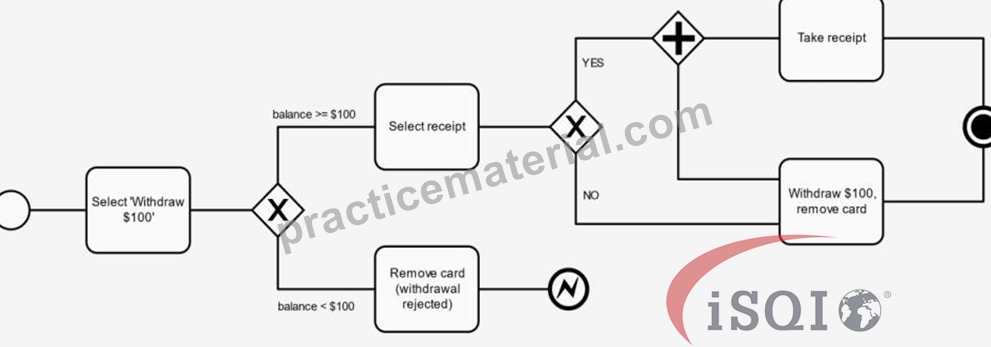
You would like to achieve decision coverage. Consider the following test cases: Test 1: balance = $100, receipt = YES Test 2: balance = $99 Test 3: balance = $120, receipt = NO Test 4: balance = $2500, receipt = YES Which of the following is the minimal set of test cases allowing to achieve full decision coverage?
- A. Test 1, Test 2, Test 4
- B. Test 1, Test 2, Test 3
- C. Test 2, Test 3
- D. Test 1, Test 2
Answer: D
Explanation:
The goal here is to achieve full decision coverage (also known as branch coverage), which means each decision point in the process must evaluate to both TRUE and FALSE at least once during testing.
From the BPMN ATM withdrawal model, we identify two key decisions:
Is the balance # $100?
If yes, is receipt = YES?
To achieve full decision coverage:
One test must evaluate decision 1 as TRUE and another as FALSE.
If decision 1 is TRUE, then decision 2 must be exercised both ways (receipt = YES and NO), but for minimal decision coverage, one path through decision 2 is enough.
Analyzing test cases:
Test 1 (balance = $100, receipt = YES): decision 1 = TRUE, decision 2 = TRUE Test 2 (balance = $99): decision 1 = FALSE These two tests ensure:
Decision 1 evaluated TRUE (Test 1) and FALSE (Test 2)
Decision 2 evaluated at least once (receipt = YES in Test 1)
Thus, Test 1 and Test 2 form the minimal set for full decision coverage.
Other options:
C and D are redundant for the minimal set.
A includes an extra test not needed for minimal decision coverage.
NEW QUESTION # 44
Which one of the following test design techniques fits accepting testing purposes BEST?
- A. static code analysis
- B. input validation
- C. equivalence partitioning
- D. defect-based test design
Answer: C
Explanation:
Equivalence Partitioning (EP) is a black-box test design technique that divides input data into valid and invalid partitions, where each partition is expected to exhibit similar behavior. In the context of acceptance testing, EP is especially effective because it helps validate whether a system behaves correctly for representative input ranges defined in the acceptance criteria.
Acceptance testing aims to confirm that the system meets business requirements and handles inputs as expected. EP allows the tester to cover a large input space using fewer test cases while maintaining a high level of effectiveness. It supports efficiency, broad coverage, and relevance to user expectations.
Other options are less suitable:
A). Static code analysis is a white-box technique, more relevant to unit or integration testing.
B). Input validation is an objective or activity, not a test design technique.
D). Defect-based testing is more diagnostic, used after failures or during exploratory testing - less structured for planned acceptance testing.
Exact Reference - ISTQB CTFL Acceptance Testing Syllabus (Section 2.4):
"Black-box techniques such as equivalence partitioning and boundary value analysis are suitable for deriving acceptance tests from user stories or business rules."
NEW QUESTION # 45
The project team is currently facing a difficult situation originating from their difficulty in envisioning the future and the necessary steps to reach it together with a certain loss of motivation due to a strong feeling of stagnation. You try to unlock the situation by proposing a workshop. Which one would fit the best?
- A. You ask two volunteers to play a part in front of the team. One will try to defend the project and propose positive arguments and ways forward. The other will do the opposite. You then recapitulate the major arguments of both sides and debate them openly with the team.
- B. You organize a day out with challenging physical exercises practiced in teams followed by an afterwork dinner and drink. After all, nothing is best for motivation than hard times together, strong common objectives and a promise of good time.
- C. You visualize all remaining major milestones of the project, starting with today and ending with project release. Then, you ask the team to identify and discuss the necessary actions to move forward from the present situation and to reach the milestones.
- D. You draw a staircase with 11 steps, each of them representing a major milestone of the project. The bottom of the stairs corresponds to the first day of the project and the upper step means that the project is released. You locate the present situation in the middle of the stairs. The team is asked to identify and discuss the major steps down and up.
Answer: D
NEW QUESTION # 46
You recently became an acceptance tester in a cross-discipline project, because your predecesor left the company over nogth. The 15 project team members are located in different time zones. Everybody seems to work hard on their tasks, but nobody can give you with an overview on the project.
What one of the following actions is BEST to encourage the team members to work closer together?
- A. You organize a workshop with all team members to establish common understanding and to lay the foundation for fruitful trusting collaboration
- B. You write a long e-mail summarizing your understanding of the project goals, its current difficulties and indicate the steps required to solve the problem.
- C. You establish a test management tool to make sure everybody has Access to the requirements and their related test cases.
- D. Knowing about the importance of the personal interactions, you travel from site to site to meet with every project team member and collect their vision
Answer: A
Explanation:
In cross-functional, globally distributed teams, establishing collaboration, communication, and trust is key. A workshop (even virtual) is a proven method for initiating alignment, especially when a new team member joins, and project coordination is weak.
Option A promotes transparency and collective understanding, crucial for building team cohesion.
Option B is too passive and one-directional. Long emails rarely solve coordination problems in Agile or collaborative contexts.
Option C is about tool setup, not team integration or communication - tools are supportive but not substitutes for human connection.
Option D is not efficient; traveling to meet each team member is impractical and doesn't guarantee a shared team vision.
A). You organize a workshop with all team members to establish common understanding and to lay the foundation for fruitful trusting collaboration.
NEW QUESTION # 47
Suppose you are testing a new professional exam support system. As input the system takes two grades from two exams. For each exam the possible grade is 0 or 1 point. As output the system returns a single string - the decision about the entitlements: if the total score is 2, the candidate receives full entitlements. If the total score is 1, she receives partial entitlements. If the total score is 0, the candidate fails and receives no entitlements.
Which of the following is the correct Decision Model and Notation (DMN) model for this situation?

- A. Option B
- B. Option D
- C. Option A
- D. Option C
Answer: C
NEW QUESTION # 48
Which one of the following statements BEST explains how the quality of requirements / user stories and acceptance criteria affects acceptance testing?
- A. INVEST is a technique that ensure the quality of user stories or requirements, thus replacing regular reviews
- B. Vague or ambiguous requirements may lead to misunderstandings both during implementation and testing
- C. In Agile development lifecycle models, requirement engineering becomes less important due to the product owner role.
- D. Testers may complete unclear requirements by assumptions, as login as they discuss those assumptions with at least one stakeholder
Answer: B
Explanation:
Clear, complete, and testable requirements or user stories are critical for effective acceptance testing.
Ambiguities or vague statements lead to differing interpretations by stakeholders, developers, and testers. This often results in software that doesn't meet user expectations or in tests that fail to verify business needs correctly.
Option B is correct because it highlights the importance of precise requirements in both implementation and testing phases. Ambiguities can result in incorrect behavior, untestable features, or test cases that don't align with business goals.
Other options:
A is risky - while testers may explore assumptions during exploratory testing, relying on assumptions rather than clarification increases risk.
C is incorrect - the INVEST mnemonic helps write better user stories, but it doesn't replace review or validation processes.
D is false - Agile still values requirements engineering; it's more collaborative and incremental, with the product owner playing a key role, not diminishing its importance.
B). Vague or ambiguous requirements may lead to misunderstandings both during implementationand testing
NEW QUESTION # 49
Which of the following statements describes an advantage of bi-directional traceability between requirements
/ user stories and test cases?
- A. Testers can easily identify the source code module that most probably causes the defects observed during test execution
- B. Test case reviewers can verify whether the test case covers all acceptance criteria of the linked requirement / user story
- C. Project managers and/or product owner can analyze the coverage of test cases for a given requirement / user story
- D. Business analysts can verify the completeness of the user stories / requirements with respect to business needs
Answer: C
Explanation:
Bi-directional traceability is a fundamental concept in requirements engineering and test management. It refers to the ability to trace:
Forward: From requirements/user stories to corresponding test cases (to ensure all requirements are covered).
Backward: From test cases to the requirements they validate (to ensure every test aligns with a requirement).
According to the ISTQB Certified Tester Foundation Level and Acceptance Testing syllabi, bi-directional traceability is essential to manage test coverage and ensure completeness. It allows project managers and product owners to assess whether all specified requirements/user stories have been covered by appropriate test cases, helping to identify any untested functionality.
This also supports impact analysis during change management - knowing which test cases will be affected by a change in a requirement.
Option B is correct because it precisely captures this benefit. While Option C refers to reviewing test cases against acceptance criteria (a valid review activity), the bi-directional traceability's key benefit from a management and quality assurance perspective is traceability for coverage.
NEW QUESTION # 50
Which one of the following statements describes an exploratory test charter BEST?
- A. Each exploratory test charter is based on a previously defined list of activities that would be interesting to test.
- B. Acceptance testers use the exploratory test charter during the testing session to define the test oracle.
- C. The test charter is elaborated during the testing session according to test execution results.
- D. Indicating that the tester should take the role of a novice user can be part of an exploratory test charter.
Answer: D
NEW QUESTION # 51
Which of the following statements regarding defects is MOST correct?
- A. If the defect turns out to be a bug, the tester writes a defect report and sends it to the business analyst for further investigation.
- B. The tester should analyze the potential impact of a defect on system usage, before communicating it to the business analyst.
- C. Testers should provide accurate information regarding the difference between the expected test result and the actual result.
- D. Regular meetings between business analysts and testers are necessary to report discrepancies between actual and expected outcome.
Answer: C
NEW QUESTION # 52
The project team is currently facing a difficult situation originating from their difficulty in envisioning the future and the necessary steps to reach it together with a certain loss of motivation due to a strong feeling of stagnation. You try to unlock the situation by proposing a workshop. Which one would fit the best?
- A. You ask two volunteers to play a part in front of the team. One will try to defend the project and propose positive arguments and ways forward. The other will do the opposite. You then recapitulate the major arguments of both sides and debate them openly with the team.
- B. You organize a day out with challenging physical exercises practiced in teams followed by an afterwork dinner and drink. After all, nothing is best for motivation than hard times together, strong common objectives and a promise of good time.
- C. You visualize all remaining major milestones of the project, starting with today and ending with project release. Then, you ask the team to identify and discuss the necessary actions to move forward from the present situation and to reach the milestones.
- D. You draw a staircase with 11 steps, each of them representing a major milestone of the project. The bottom of the stairs corresponds to the first day of the project and the upper step means that the project is released. You locate the present situation in the middle of the stairs. The team is asked to identify and discuss the major steps down and up.
Answer: D
Explanation:
In situations where a team is demotivated or struggling with vision and direction, it's effective to use visualization workshops that help the team reflect on progress and visualize a path forward.
Option B describes a metaphorical workshop using a staircase to represent the project's journey - this is known as the "Stairway Retrospective" or "Timeline Workshop". It provides a shared mental model, identifies milestones, and encourages discussion around past progress and future steps. It's ideal for reigniting motivation and clarifying direction - which aligns with the issue described in the question.
Other options:
A can spark debate but may not be constructive or motivating in a stagnation scenario.
C may foster team bonding but doesn't directly address project direction or vision.
D focuses only on future milestones and lacks the reflective component essential when a team feels stuck.
NEW QUESTION # 53
Which one of the following combinations of given perspective and statement matches BEST?
- A. From a technical perspective, the number of concurrent user and the types of transactions performed are major elements.
- B. From a user perspective, missing feedback from the system when processing a request it is a problem.
- C. From a business perspective, the choice of performance test tools strongly depends on the applied test techniques.
- D. From a business perspective, computing power and architecture are major parameters for fine- tuning the system.
Answer: B
Explanation:
In usability and user experience, system feedback is critical. Users expect clear, timely responses from the system to confirm their actions are received and processed. Lack of feedback (e.g., when clicking a button yields no visual response) leads to confusion, frustration, or repeated actions.
Option B is correct because it highlights a genuine issue from a user's perspective - inadequate feedback, which affects usability and satisfaction.
Other options:
A focuses on technical infrastructure (architecture, computing power) - a technical or business concern, but less so from a user's lens.
C is mostly correct but fits the technical or test engineer's perspective rather than the user's.
D is inaccurate - selection of performance tools is primarily a technical/test management decision, not business-driven.
B). From a user perspective, missing feedback from the system when processing a request is a problem.
NEW QUESTION # 54
How does ISTQB CTFL test activities relate to the IQBBA FL business analysis and requirements engineering activities?
- A. Business analysts who follow the IQBBA requirements engineering process will not be involved in designing test cases.
- B. The IQBBA solution evaluation phase precedes the ISTQB test implementation and test execution activities.
- C. Test analysis and test design activities may result in changes of acceptance criteria.
- D. Business analysts and tester have to decide, whether they follow the IQBBA or ISTQB lifecycle processes, because they exclude each other.
Answer: C
NEW QUESTION # 55
......
The CTFL-AcT exam covers a variety of topics related to acceptance testing, including the purpose and benefits of acceptance testing, different types of acceptance testing, the roles and responsibilities of stakeholders in acceptance testing, and the use of tools and techniques for acceptance testing. CTFL-AcT exam is designed to test the candidate's understanding of these topics through a combination of multiple-choice and scenario-based questions.
CTFL-AcT Exam Dumps For Certification Exam Preparation: https://www.practicematerial.com/CTFL-AcT-exam-materials.html
Online VALID CTFL-AcT Exam Dumps File Instantly: https://drive.google.com/open?id=1Dm_4Q9cyKepawSaOm777Q5s8-PirpkYN
