

Verified CTFL4 Q&As - Pass Guarantee CTFL4 Exam Dumps
Check the Free demo of our CTFL4 Exam Dumps with 190 Questions
BCS CTFL4 Exam Syllabus Topics:
| Topic | Details |
|---|---|
| Topic 1 |
|
| Topic 2 |
|
| Topic 3 |
|
| Topic 4 |
|
NEW QUESTION # 43
Which statement is true regarding confirmation testing and regression testing?
- A. Confirmation testing is an optional activity whilst regression testing is not negotiable.
- B. Confirmation testing aims to verify that a defect has been resolved and regression testing ensuring that existing functionality still works after a change.
- C. Confirmation testing confirms the quality of the test being run while regression testing ensures that the software still works after a change has been made.
- D. Testers' involvement is essential whilst running retesting and regression testing.
- E. TESTER Involvement is essential whilst running retesting and regression testing.
Answer: B
Explanation:
Confirmation testing, also known as retesting, is conducted to verify that specific defects have been fixed.
Regression testing, on the other hand, is performed to ensure that recent changes have not adversely affected existing features of the software. Both types of testing are crucial for maintaining the integrity and quality of the software after modifications.
NEW QUESTION # 44
Which of the following statements best describes the difference between product risk and project risk in software testing?
- A. Product risk refers to the risk associated with the project's schedule, budget, and resources, while project risk refers to the risk associated with the quality and functionality of the software product.
- B. Product risk refers to the risk associated with delays in elements such as work product deliveries and inaccurate estimates, while project risk refers to the risk associated with issues such as user dissatisfaction.
- C. Product risk and project risk are essentially the same and can be used interchangeably.
- D. Product risk refers to the risk associated with issues such as delays in work product deliveries, inaccurate estimates, while project risk refers to the risk associated with the project's schedule, budget, and resources.
Answer: D
Explanation:
Product risk involves the potential issues that can affect the quality and functionality of the software product, such as defects, performance problems, and usability issues. Project risk, on the other hand, relates to the risks that can impact the project's schedule, budget, and resources, such as delays, cost overruns, and resource constraints. Understanding both types of risks is crucial for managing and mitigating potential problems in software projects.
References:ISTQB CTFL Syllabus, Section 5.2.1, "Risk Management in Testing."
NEW QUESTION # 45
What type of testing measures its effectiveness by tracking which lines of code were executed by the tests?
- A. Exploratory testing
- B. Acceptance testing
- C. Integration testing
- D. Structural testing
Answer: D
Explanation:
Structural testing is a type of testing that measures its effectiveness by tracking which lines of code were executed by the tests. Structural testing, also known as white-box testing or glass-box testing, is based on the internal structure, design, or implementation of the software. Structural testing aims to verify that the software meets the specified quality attributes, such as performance, security, reliability, or maintainability, by exercising the code paths, branches, statements, conditions, or data flows. Structural testing uses various coverage metrics, such as function coverage, line coverage, branch coverage, or statement coverage, to determine how much of the code has been tested and to identify any untested or unreachable parts of the code.
Structural testing can be applied at any level of testing, such as unit testing, integration testing, system testing, or acceptance testing, but it is more commonly used at lower levels, where the testers have access to the source code.
The other options are not correct because they are not types of testing that measure their effectiveness by tracking which lines of code were executed by the tests. Acceptance testing is a type of testing that verifies that the software meets the acceptance criteria and the user requirements. Acceptance testing is usually performed by the end-users or customers, who may not have access to the source code or the technical details of the software. Acceptance testing is more concerned with the functionality, usability, or suitability of the software, rather than its internal structure or implementation. Integration testing is a type of testing that verifies that the software components or subsystems work together as expected. Integration testing is usually performed by the developers or testers, who may use both structural and functional testing techniques to check the interfaces, interactions, or dependencies between the components or subsystems. Integration testing is more concerned with the integration logic, data flow, or communication of the software, rather than its individual lines of code. Exploratory testing is a type of testing that involves simultaneous learning, test design, and test execution. Exploratory testing is usually performed by the testers, who use their creativity, intuition, or experience to explore the software and discover any defects, risks, or opportunities for improvement. Exploratory testing is more concerned with the behavior, quality, or value of the software, rather than its internal structure or implementation. References = ISTQB Certified Tester Foundation Level (CTFL) v4.0 syllabus, Chapter 4: Test Techniques, Section 4.3: Structural Testing Techniques, Pages 51-54; Chapter 1: Fundamentals of Testing, Section 1.4: Testing Throughout the Software Development Lifecycle, Pages 11-13; Chapter 3: Static Testing, Section 3.4: Exploratory Testing, Pages 40-41.
NEW QUESTION # 46
Which of the following is a test task that usually occurs during test implementation?
- A. Make sure the planned test environment is ready to be delivered
- B. Find, analyze, and remove the causes of the failures highlighted by the tests
- C. Gather the metrics that are used to guide the test project
- D. Archive the testware for use in future test projects
Answer: A
Explanation:
A test task that usually occurs during test implementation is to make sure the planned test environment is ready to be delivered. The test environment is the hardware and software configuration on which the tests are executed, and it should be as close as possible to the production environment where the software system will operate. The test environment should be planned, prepared, and verified before the test execution, to ensure that the test conditions, the test data, the test tools, and the test interfaces are available and functional. The other options are not test tasks that usually occur during test implementation, but rather test tasks that occur during other test activities, such as:
Find, analyze, and remove the causes of the failures highlighted by the tests: This is a test task that usually occurs during test analysis and design, which is the activity of analyzing the test basis, designing the test cases, and identifying the test data. During this activity, the testers can use techniques such as root cause analysis, defect prevention, or defect analysis, to find, analyze, and remove the causes of the failures highlighted by the previous tests, and to prevent or reduce the occurrence of similar failures in the future tests.
Archive the testware for use in future test projects: This is a test task that usually occurs during test closure, which is the activity of finalizing and reporting the test results, evaluating the test process, and identifying the test improvement actions. During this activity, the testers can archive the testware, which are the test artifacts produced during the testing process, such as the test plan, the test cases, the test data, the test results, the defect reports, etc., for use in future test projects, such as regression testing, maintenance testing, or reuse testing.
Gather the metrics that are used to guide the test project: This is a test task that usually occurs during test monitoring and control, which is the activity of tracking and reviewing the test progress, status, and quality, and taking corrective actions when necessary. During this activity, the testers can gather the metrics, which are the measurements of the testing process, such as the test coverage, the defect density, the test effort, the test duration, etc., that are used to guide the test project, such as planning, estimating, scheduling, reporting, or improving the testing process. Reference: ISTQB Certified Tester Foundation Level (CTFL) v4.0 sources and documents:
ISTQB Certified Tester Foundation Level Syllabus v4.0, Chapter 2.1.1, Test Planning1 ISTQB Certified Tester Foundation Level Syllabus v4.0, Chapter 2.1.2, Test Monitoring and Control1 ISTQB Certified Tester Foundation Level Syllabus v4.0, Chapter 2.1.3, Test Analysis and Design1 ISTQB Certified Tester Foundation Level Syllabus v4.0, Chapter 2.1.4, Test Implementation1 ISTQB Certified Tester Foundation Level Syllabus v4.0, Chapter 2.1.5, Test Execution1 ISTQB Certified Tester Foundation Level Syllabus v4.0, Chapter 2.1.6, Test Closure1 ISTQB Glossary of Testing Terms v4.0, Test Environment, Test Condition, Test Data, Test Tool, Test Interface, Failure, Root Cause Analysis, Defect Prevention, Defect Analysis, Testware, Regression Testing, Maintenance Testing, Reuse Testing, Test Coverage, Defect Density, Test Effort, Test Duration2
NEW QUESTION # 47
Match each objective to the correct test level
Objective:
A) Verifying whether the functional and non-functlonal behaviors of the system are as designed and specified.
B) Verifying whether the functional and non-functlonal behaviors of the interfaces are as designed.
C) Verifying whether the functional and non-functional behaviors of the components are as designed and specified.
D) Establishing confidence in the quality of the system as a whole.
Test Level:
1. Component testing.
2. Integration testing.
3. System testing.
4. Acceptance testing.
- A. A3. B2. C1. D4
- B. A2, B3, Cl, D4
- C. A3, B2. C4. D1
Answer: A
Explanation:
The test levels and their objectives can be matched as follows:
Verifying whether the functional and non-functional behaviors of the system are as designed and specified (A3: System testing).
Verifying whether the functional and non-functional behaviors of the interfaces are as designed (B2: Integration testing).
Verifying whether the functional and non-functional behaviors of the components are as designed and specified (C1: Component testing).
Establishing confidence in the quality of the system as a whole (D4: Acceptance testing).
NEW QUESTION # 48
Which ONE of the following options BEST describes Behavior-Driven Development (BDD)?
- A. Defines test cases at a low level, close to the implementation, using unit test frameworks.
- B. Expresses the desired behavior of an application with test cases written in a simple form of natural language that is easy to understand by stakeholders-usually using the Given/When/Then format. Test cases are then automatically translated into executable tests.
- C. Requires testing to be performed after development is completed to validate software functionality.
- D. Is primarily focused on non-functional testing techniques to ensure system reliability and performance.
Answer: B
Explanation:
Comprehensive and Detailed In-Depth Explanation:BDD emphasizes collaboration between developers, testers, and business stakeholders to define system behavior in a readable format (A). It typically uses the Given-When-Thensyntax. Unlike unit testing (B), BDD is at a higher level of abstraction. It does not focus solely on non-functional testing (C) and encourages early testing rather than post-development validation (D).
NEW QUESTION # 49
You are performing the role of tester on an Agile project. Which of the following tasks would be your responsibility?
i. Understanding, implementing, and updating the test strategy.
II. Ensuring the proper use of testing tools.
Hi. Coaching other team members in the relevant aspects of testing.
iv. Actively collaborating with developers and business stakeholders to clarify requirements, especially in terms of testability, consistency, and completeness.
v. Participating proactively in team retrospective meeting, suggesting and implementing improvements.
Select the correct answer:
- A. i, iii and v
- B. i, ii and iii
- C. i, iv and v
- D. iii. iv and v
Answer: C
Explanation:
In an Agile project, a tester's responsibilities include understanding, implementing, and updating the test strategy (i), actively collaborating with developers and business stakeholders to clarify requirements, especially in terms of testability, consistency, and completeness (iv), and participating proactively in team retrospective meetings, suggesting and implementing improvements (v). These activities ensure that testing is integrated into the development process, promoting continuous feedback and improvement. The ISTQB CTFL syllabus underlines the collaborative nature of Agile testing and the tester's role in contributing to the team's overall quality goals.
References:ISTQB CTFL Syllabus, Section on Agile Testing Practices.
NEW QUESTION # 50
Which of the following statements is incorrect regarding the involvement of testers in the software development lifecycle (SDLC)?
- A. Testers should only be involved during the testing phase.
- B. Testers should be involved from the beginning of the SDLC to increase understanding of design decisions and detect defects early.
- C. Testers' involvement is essential; developers find it difficult to be objective.
- D. Testers should contribute to all activities in the SDLC and participate in design discussions.
Answer: A
Explanation:
Involving testers only during the testing phase is incorrect as per the ISTQB CTFL syllabus. Effective involvement of testers is crucial throughout the entire software development lifecycle (SDLC). This includes early stages such as requirement analysis and design, which allows testers to understand the design decisions and detect defects early. Early involvement helps in better understanding the project and ensures that quality is built into the product from the beginning. Furthermore, the ISTQB syllabus emphasizes the importance of testers contributing to all activities in the SDLC, including design discussions, to enhance defect detection and prevention.
References:ISTQB CTFL Syllabus, Section 2.1.1, "The Influence of Development Models on Testing" and Section 1.1.1, "Test Objectives."
NEW QUESTION # 51
Which of the following statements best describes the way in which decision coverage is measured?
- A. Measured as the number of decision outcomes executed by the tests, divided by the total number of decision outcomes in the test object.
- B. It is not possible to accurately measure decision coverage.
- C. Measured as the number of lines of code executed by the tests, divided by the total number of lines of code in the test object.
- D. Measured as the number of statements executed by the tests, divided by the total number of executable statements in the code.
Answer: A
NEW QUESTION # 52
Which of the following best describes the way in which statement coverage is measured?
- A. It is not possible to accurately measure statement coverage.
- B. Measured as the number of decision outcomes executed by the tests, divided by the total number of decision outcomes in the test object.
- C. Measured as the number of lines of code executed by the test, divided by the total number of lines of code in the test object.
- D. Measured as the number of statements executed by the tests, divided by the total number of executable statements in the code.
Answer: D
Explanation:
Statement coverage is a metric used in white-box testing that measures the percentage of executable statements in the code that have been executed by the test cases. It is calculated as the number of statements executed by the tests divided by the total number of executable statements in the code, providing an indication of how much of the code has been tested.
NEW QUESTION # 53
Which ONE of the following options BEST describes black-box test techniques?
- A. Black-box testing techniques are based on analyzing the test object's specified and implied behavior without knowledge of its internal data structure.
- B. Black-box testing techniques involve analyzing the specified behavior of the test object without knowledge of its internal structure.
- C. Black-box testing techniques are based on experience with the test object without knowing the internal structure.
- D. In black-box testing techniques, test cases are created based on the software's implementation.
Answer: B
Explanation:
Comprehensive and Detailed In-Depth Explanation:Black-box testing techniques focus ontesting the functionality of the software without knowledge of its internal workings(D). They derive test cases from specifications, requirements, or expected behavior.Option Adescribes exploratory testing,Bcontradicts the definition by focusing on implementation, andCincorrectly includes "implied behavior," which is not a core characteristic of black-box testing.
NEW QUESTION # 54
Which of the following statements about static testing and dynamic testing is true?
- A. Both static testing and dynamic testing can be used to highlight issues associated with non-functional characteristics
- B. Unlike dynamic testing, which can be also performed manually, static testing cannot be performed without specialized tools
- C. Static testing is usually much less cost-effective than dynamic testing
- D. Unlike dynamic testing, which focuses on detecting potential defects, static testing focuses on detecting failures which may be due to actual defects
Answer: A
Explanation:
This answer is correct because static testing and dynamic testing are both types of testing that can be used to highlight issues associated with non-functional characteristics, such as usability, performance, security, reliability, etc. Static testing is a type of testing that involves the analysis of software work products, such as requirements, design, code, or test cases, without executing them. Dynamic testing is a type of testing that involves the execution of software work products, such as code or test cases, using inputs and verifying outputs. Both static testing and dynamic testing can be applied to different test levels and test types, and can use different test techniques and tools, to evaluate the non-functional characteristics of the software product. Reference: ISTQB Glossary of Testing Terms v4.0, ISTQB Foundation Level Syllabus v4.0, Section 2.2.1.1, Section 2.2.1.2
NEW QUESTION # 55
Match each objective to the correct test level
Objective:
A)Verifying whetherthe functionalandnon-functlonalbehaviorsof the system are as designed andspecified.
B)Verifying whetherthe functionalandnon-functlonalbehaviorsof the interfaces are as designed.
C)Verifying whetherthe functionalandnon-functionalbehaviorsof the components are as designedand specified.
D)Establishing confidence in the quality of the systemas a whole.
Test Level:
1.Component testing.
2.Integration testing.
3.System testing.
4.Acceptance testing.
- A. A3.B2. C1. D4
- B. A3, B2.C4. D1
- C. A2, B3, Cl, D4
Answer: A
Explanation:
The test levels and their objectives can be matched as follows:
* Verifying whether the functional and non-functional behaviors of the system are as designed and specified (A3: System testing).
* Verifying whether the functional and non-functional behaviors of the interfaces are as designed (B2:
Integration testing).
* Verifying whether the functional and non-functional behaviors of the components are as designed and specified (C1: Component testing).
* Establishing confidence in the quality of the system as a whole (D4: Acceptance testing).
NEW QUESTION # 56
Which ONE of the following statements BEST applies tochecklist-based testing?
- A. Checklists should contain general guidelines to ensure that all aspects of the software are covered.
- B. Checklists should primarily consist of automated test cases to maximize efficiency.
- C. Checklists should be used exclusively for functional testing, as they are unsuitable for non-functional testing.
- D. Checklists should contain specific test conditions that can be individually and directly checked.
Answer: D
Explanation:
Comprehensive and Detailed In-Depth Explanation:Checklist-based testingusesspecific test conditions (B) that help testers ensure key aspects are validated. The checklist items can be derived from past defects, requirements, or regulatory standards.
* (A) is incorrectbecause general guidelines lack specificity.
* (C) is incorrectbecause checklists can be used for both manual and automated testing.
* (D) is incorrectbecause checklists are useful for both functional and non-functional testing (e.g., security, performance).
Checklistshelp ensure completenesswithout enforcingstrictly scriptedexecution.
NEW QUESTION # 57
Which of the following statements is not correct?
- A. Looking for defects in system requires professional pessimism and curiosity
- B. Testing is often seen as a destructive activity instead of constructive activity
- C. Identifying defects may be perceived as criticism against product
- D. Looking for defects in a system may require Ignoring system details
Answer: D
Explanation:
Looking for defects in a system does not require ignoring system details, but rather paying attention to them and understanding how they affect the system's quality, functionality, and usability. Ignoring system details could lead to missing important defects or testing irrelevant aspects of the system.
Identifying defects may be perceived as criticism against product, especially by the developers or stakeholders who are invested in the product's success. However, identifying defects is not meant to be a personal attack, but rather a constructive feedback that helps to improve the product and ensure its alignment with the requirements and expectations of the users and clients.
Looking for defects in system requires professional pessimism and curiosity, as testers need to anticipate and explore the possible ways that the system could fail, malfunction, or behave unexpectedly. Professional pessimism means being skeptical and critical of the system's quality and reliability, while curiosity means being eager and interested in finding out the root causes and consequences of the defects.
Testing is often seen as a destructive activity instead of constructive activity, as it involves finding and reporting the flaws and weaknesses of the system, rather than creating or enhancing it. However, testing is actually a constructive activity, as it contributes to the system's improvement, verification, validation, and optimization, and ultimately to the delivery of a high-quality product that meets the needs and expectations of the users and clients.
NEW QUESTION # 58
Which of the following statements is TRUE'?
- A. Functional testing can be applied to all test levels, while non-functional testing can be applied only to system and acceptance test levels.
- B. Black-box test techniques and experience-based test techniques may be applicable to both functional testing and non-functional testing
- C. Functional testing focuses on what the system is supposed to do, while white-box testing focuses on how well the system does what it is supposed to do
- D. Unlike functional testing, non-fundional testing can only be applied to conventional systems, not artificial intelligence-based system.
Answer: B
Explanation:
Statement D is correct. According to the ISTQB CTFL syllabus, both black-box test techniques (which focus on testing without internal knowledge of the application) and experience-based test techniques (which rely on testers' experience and intuition) can be applied to both functional and non-functional testing. Functional testing is concerned with what the system does, whereas non-functional testing looks at how the system performs under certain conditions. These techniques are versatile and can be employed to address both these aspects.
NEW QUESTION # 59
For each of the test cases to be executed, the following table specifies the priority order and dependencies on other test cases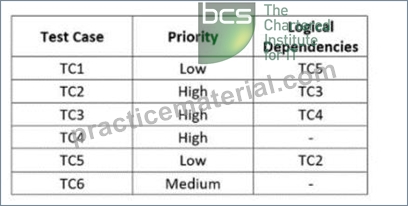
Which of the following test execution schedules is compatible with the logical dependencies and allows executing the test cases in priority order?
- A. TC3, TC5, TC6, TC1, TC4, TC3
- B. TC4, TC6, TC3, TC2, TC5, TC1
- C. TC4, TC3, TC2, TC6, TC1, TC5
- D. TC4, TC3, TC2, TC6, TC5. TC1
Answer: C
Explanation:
This answer is correct because it follows the logical dependencies and allows executing the test cases in priority order. TC4, TC3, and TC2 are executed first because they have the highest priority. TC6 is executed next because it has a logical dependency on TC2. TC1 is executed next because it has a logical dependency on TC5. Finally, TC5 is executed last because it has the lowest priority. Reference: ISTQB Certified Tester Foundation Level (CTFL) v4.0 documents
NEW QUESTION # 60
Which of the following coverage criteria results in the highest coverage for state transition based test cases?
- A. Can't be determined
- B. Covering only start and end states
- C. Covering all transitions at least once
- D. Covering all states at least once
Answer: C
Explanation:
Covering all transitions at least once is the highest coverage criterion for state transition based test cases, because it ensures that every possible change of state is tested at least once. This means that all the events that trigger the transitions, as well as the actions and outputs that result from the transitions, are verified. Covering all transitions at least once also implies covering all states at least once, but not vice versa. Therefore, option D is not the highest coverage criterion. Option C is the lowest coverage criterion, because it only tests the initial and final states of the system or component, without checking the intermediate states or transitions.
Option A is incorrect, because the coverage criteria for state transition based test cases can be determined and compared based on the number of transitions and states covered. References = CTFL 4.0 Syllabus, Section
4.2.3, page 49-50.
NEW QUESTION # 61
Which ONE of the following options BEST describes a key characteristic of non-functional testing?
- A. Conducting non-functional testing exclusively at the acceptance test level.
- B. Ensuring non-functional testing focuses only on user experience and usability.
- C. Performing non-functional testing starting at the system test level.
- D. Limiting non-functional testing to security testing and performance testing only.
Answer: C
Explanation:
Comprehensive and Detailed In-Depth Explanation:Non-functional testing evaluates attributes like performance, security, and usability, which are typically assessed at thesystem test level or higher(A). It is not restricted to acceptance testing (B), goes beyond security and performance testing (C), and covers more than just user experience (D).
NEW QUESTION # 62
The following decision table is used to assist a doctor in determining the drug therapy to prescribe for a patient (aged 6 to 65 years) diagnosed with acute sinusitis. The table consists of three Boolean conditions and six actions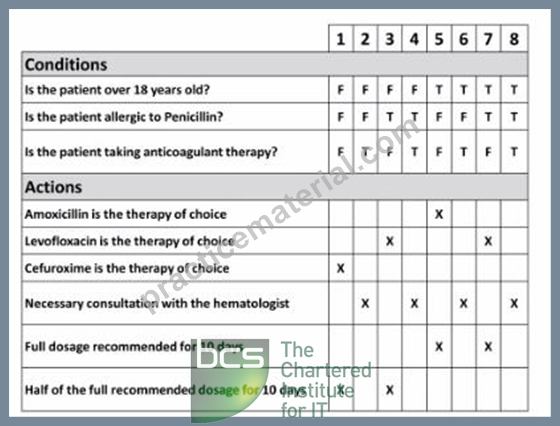
Based only on the given information, which of the following statements is TRUE?
- A. Columns 5 and 7 can be merged into a single column
- B. Columns 2, 4, 6 and 8 can be merged into a single column
- C. Column 7 represents an impossible situation and thus can be deleted
- D. Columns 1 and 3 can be merged into a single column
Answer: D
Explanation:
Decision tables are used to model complex decision logic by considering different combinations of conditions and actions. Based on the given decision table for prescribing drug therapy:
Column 1 and Column 3 both result in the same actions (prescribing Amoxicillin).
These columns can be merged because the actions taken do not depend on whether the patient is taking anticoagulant therapy (both are 'T' for this condition).
Thus, combining these columns simplifies the decision table without losing any information.
NEW QUESTION # 63
......
Get professional help from our CTFL4 Dumps PDF: https://www.practicematerial.com/CTFL4-exam-materials.html
Clear your concepts with CTFL4 Questions Before Attempting Real exam: https://drive.google.com/open?id=1yh2rWCckzPu-eYQqX7gkz1rW_jTbPWg6
