

2024 MuleSoft-Integration-Architect-I exam torrent MuleSoft-Integration-Architect-I Study Guide
Easily pass MuleSoft-Integration-Architect-I Exam with our Dumps & PDF Test Engine
NEW QUESTION # 145
What is not true about Mule Domain Project?
- A. Expose multiple services within the Mule domain on the same port
- B. This allows Mule applications to share resources
- C. Send events (messages) to other Mule applications using VM queues
- D. Only available Anypoint Runtime Fabric
Answer: D
Explanation:
* Mule Domain Project is ONLY available for customer-hosted Mule runtimes, but not for Anypoint Runtime Fabric
* Mule domain project is available for Hybrid and Private Cloud (PCE). Rest all provide application isolation and can't support domain project.
What is Mule Domain Project?
* A Mule Domain Project is implemented to configure the resources that are shared among different projects. These resources can be used by all the projects associated with this domain. Mule applications can be associated with only one domain, but a domain can be associated with multiple projects. Shared resources allow multiple development teams to work in parallel using the same set of reusable connectors. Defining these connectors as shared resources at the domain level allows the team to: - Expose multiple services within the domain through the same port. - Share the connection to persistent storage. - Share services between apps through a well-defined interface. - Ensure consistency between apps upon any changes because the configuration is only set in one place.
* Use domains Project to share the same host and port among multiple projects. You can declare the http connector within a domain project and associate the domain project with other projects. Doing this also allows to control thread settings, keystore configurations, time outs for all the requests made within multiple applications. You may think that one can also achieve this by duplicating the http connector configuration across all the applications. But, doing this may pose a nightmare if you have to make a change and redeploy all the applications.
* If you use connector configuration in the domain and let all the applications use the new domain instead of a default domain, you will maintain only one copy of the http connector configuration. Any changes will require only the domain to the redeployed instead of all the applications.
You can start using domains in only three steps:
1) Create a Mule Domain project
2) Create the global connector configurations which needs to be shared across the applications inside the Mule Domain project
3) Modify the value of domain in mule-deploy.properties file of the applications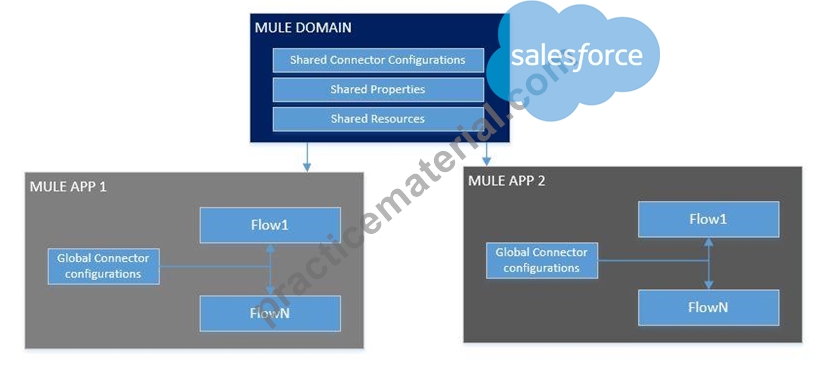
NEW QUESTION # 146
What is a defining characteristic of an integration-Platform-as-a-Service (iPaaS)?
- A. On-premises
- B. A Cloud-based
- C. No-code
- D. Code-first
Answer: B
NEW QUESTION # 147
Which type of communication is managed by a service mesh in a microservices architecture?
- A. Communication between microservices runtime administrators
- B. Communication between microservices developers
- C. Communication between microservices
- D. Communication between trading partner services
Answer: C
NEW QUESTION # 148
Which Exchange asset type represents a complete API specification in RAML or OAS format?
- A. API Spec Fragments
- B. Connectors
- C. SOAP APIs
- D. REST APIs
Answer: D
NEW QUESTION # 149
According to MuleSoft, which major benefit does a Center for Enablement (C4E) provide for an enterprise and its lines of business?
- A. Centralizing project management across the lines of business
- B. Centrally managing return on investment (ROI) reporting from lines of business to leadership
- C. Accelerating self-service by the lines of business
- D. Enabling Edge security between the lines of business and public devices
Answer: A
NEW QUESTION # 150
How does timeout attribute help inform design decisions while using JMS connector listening for incoming messages in an extended architecture (XA) transaction?
- A. The timeout specifies the time allowed to pass between receiving JMS messages on the same JMS connection and then after the timeout new JMS connection is established
- B. The timeout defines the time that is allowed to pass without the transaction ending explicitly and after the timeout expires, the transaction rolls back
- C. The time allowed to pass between committing the transaction and the completion of the mule flow and then after the timeout flow processing triggers an error
- D. After the timeout is exceeded, stale JMS consumer threads are destroyed and new threads are created
Answer: B
NEW QUESTION # 151
Refer to the exhibit.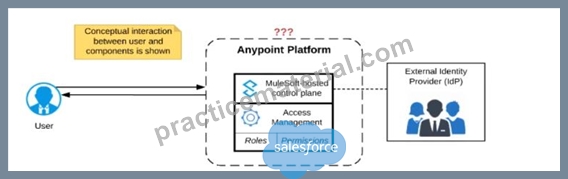
Anypoint Platform supports role-based access control (RBAC) to features of the platform. An organization has configured an external Identity Provider for identity management with Anypoint Platform.
What aspects of RBAC must ALWAYS be controlled from the Anypoint Platform control plane and CANNOT be controlled via the external Identity Provider?
- A. Removing a user's access to Anypoint Platform when they no longer work for the organization
- B. Assigning Anypoint Platform role(s) to a user
- C. Controlling the business group within Anypoint Platform to which the user belongs
- D. Assigning Anypoint Platform permissions to a role
Answer: D
Explanation:
* By default, Anypoint Platform performs its own user management
- For user management, one external IdP can be integrated with the Anypoint Platform organization (note: not at business group level)
- Permissions and access control are still enforced inside Anypoint Platform and CANNOT be controlled via the external Identity Provider * As the Anypoint Platform organization administrator, you can configure identity management in Anypoint Platform to set up users for single sign-on (SSO). * You can map users in a federated organization's group to a role which also gives the flexibility of controlling the business group within Anypoint Platform to which the user belongs to. Also user can nbe removed from external identity management system when they no longer work for the organization. So they wont be able to authenticate using SSO to login to Anypoint Platform. * Using external identity we can no change permissions of a particular role in Mulesoft Anypoint platform.
* So Correct answer is Assigning Anypoint Platform permissions to a role
NEW QUESTION # 152
Which role is primarily responsible for building API implementation as part of a typical MuleSoft integration project?
- A. API Designer
- B. Integration Architect
- C. Operations
- D. API Developer
Answer: D
NEW QUESTION # 153
What is the MuleSoft-recommended best practice to share the connector and configuration information among the APIs?
- A. Create an API proxy for each System API and share the Database connector configuration with all the API proxies via an automated policy
- B. Build a separate Mule domain project for each API, and configure each of them to use a file on a shared file store to load the configuration information dynamically
- C. Build another System API that connects to the database, and refactor all the other APIs to make requests through the new System API to access the database
- D. Build a Mule domain project, add the Database connector and configuration to it, and reference this one domain project from each System API
Answer: D
NEW QUESTION # 154
An Organization has previously provisioned its own AWS VPC hosting various servers. The organization now needs to use Cloudhub to host a Mule application that will implement a REST API once deployed to Cloudhub, this Mule application must be able to communicate securely with the customer-provisioned AWS VPC resources within the same region, without being interceptable on the public internet.
What Anypoint Platform features should be used to meet these network communication requirements between Cloudhub and the existing customer-provisioned AWS VPC?
- A. Use VM queues in the Mule application to allow any non-mule assets within the customer provisioned AWS VPC to subscribed to and receive messages
- B. Add a Mulesoft hosted Anypoint VPC configured and with VPC Peering to the AWS VPC
- C. Configure an external identity provider (IDP) in Anypoint Platform with certificates from the customer provisioned AWS VPC
- D. Add a default API Whitelisting policy to API Manager to automatically whitelist the customer provisioned AWS VPC IP ranges needed by the Mule applicaton
Answer: B
Explanation:
Correct answer is: Add a Mulesoft hosted Anypoint VPC configured and with VPC Peering to the AWS VPC * Connecting to your Anypoint VPC extends your corporate network and allows CloudHub workers to access resources behind your corporate firewall.
* You can connect on-premises data centers through a secured VPN tunnel, or a private AWS VPC through VPC peering, or by using AWS Direct Connect.
MuleSoft Doc Reference : https://docs.mulesoft.com/runtime-manager/virtual-private-cloud
NEW QUESTION # 155
An Integration Mule application is being designed to synchronize customer data between two systems. One system is an IBM Mainframe and the other system is a Salesforce Marketing Cloud (CRM) instance. Both systems have been deployed in their typical configurations, and are to be invoked using the native protocols provided by Salesforce and IBM.
What interface technologies are the most straightforward and appropriate to use in this Mute application to interact with these systems, assuming that Anypoint Connectors exist that implement these interface technologies?
- A. IBM: Active MQ CRM: REST
- B. IBM: REST CRM:REST
- C. IBM: DB access CRM: gRPC
- D. IBM: CICS CRM: SOAP
Answer: D
Explanation:
Correct answer is IBM: CICS CRM: SOAP
* Within Anypoint Exchange, MuleSoft offers the IBM CICS connector. Anypoint Connector for IBM CICS Transaction Gateway (IBM CTG Connector) provides integration with back-end CICS apps using the CICS Transaction Gateway.
* Anypoint Connector for Salesforce Marketing Cloud (Marketing Cloud Connector) enables you to connect to the Marketing Cloud API web services (now known as the Marketing Cloud API), which is also known as the Salesforce Marketing Cloud. This connector exposes convenient operations via SOAP for exploiting the capabilities of Salesforce Marketing Cloud.
NEW QUESTION # 156
An organization has deployed runtime fabric on an eight note cluster with performance profile. An API uses and non persistent object store for maintaining some of its state dat a. What will be the impact to the stale data if server crashes?
- A. State data is preserved
- B. State data is lost
- C. State data is preserved as long as more than one more is unaffected by the crash
- D. State data is rolled back to a previously saved version
Answer: B
NEW QUESTION # 157
Mule application muleA deployed in cloudhub uses Object Store v2 to share data across instances. As a part of new requirement , application muleB which is deployed in same region wants to access this Object Store.
Which of the following option you would suggest which will have minimum latency in this scenario?
- A. Object Store connector
- B. Object Store REST API
- C. Object Store of one mule application cannot be accessed by other mule application.
- D. Both of the above option will have same latency
Answer: B
Explanation:
V2 Rest API is recommended for on premise applications to access Object Store. It also comes with overhead of encryption and security of using rest api. With Object Store v2, the API call is localized to the same data center as the Runtime Manager app.
But in this case requirement is to access the OS of other mule application and not the same mule application.
You can configure a Mule app to use the Object Store REST API to store and retrieve values from an object store in another Mule app.
However, Object Store v2 is not designed for app-to-app communication.
NEW QUESTION # 158
According to the National Institute of Standards and Technology (NIST), which cloud computing deployment model describes a composition of two or more distinct clouds that support data and application portability?
- A. Private cloud
- B. Public cloud
- C. Hybrid cloud 4
- D. Community cloud
Answer: C
NEW QUESTION # 159
A Mule application is being designed to do the following:
Step 1: Read a SalesOrder message from a JMS queue, where each SalesOrder consists of a header and a list of SalesOrderLineltems.
Step 2: Insert the SalesOrder header and each SalesOrderLineltem into different tables in an RDBMS.
Step 3: Insert the SalesOrder header and the sum of the prices of all its SalesOrderLineltems into a table In a different RDBMS.
No SalesOrder message can be lost and the consistency of all SalesOrder-related information in both RDBMSs must be ensured at all times.
What design choice (including choice of transactions) and order of steps addresses these requirements?
- A. 1) Read the JMS message in an XA transaction
2) In the SAME XA transaction, perform BOTH DB inserts but do NOT acknowledge the JMS message - B. 1) Read and acknowledge the JMS message (NOT in an XA transaction)
2) In a NEW XA transaction, perform BOTH DB inserts - C. 1) Read the JMS message (NOT in an XA transaction)
2) Perform EACH DB insert in a SEPARATE DB transaction
3) Acknowledge the JMS message - D. 1) Read the JMS message (NOT in an XA transaction)
2) Perform BOTH DB inserts in ONE DB transaction
3) Acknowledge the JMS message
Answer: D
Explanation:
* Option A says "Perform EACH DB insert in a SEPARATE DB transaction". In this case if first DB insert is successful and second one fails then first insert won't be rolled back causing inconsistency. This option is ruled out.
* Option D says Perform BOTH DB inserts in ONE DB transaction.
Rule of thumb is when one or more DB connections are required we must use XA transaction as local transactions support only one resource. So this option is also ruled out.
* Option B acknowledges the before DB processing, so message is removed from the queue. In case of system failure at later point, message can't be retrieved.
* Option C is Valid: Though it says "do not ack JMS message", message will be auto acknowledged at the end of transaction. Here is how we can ensure all components are part of XA transaction: https://docs.mulesoft.com/jms-connector/1.7/jms-transactions Additional Information about transactions:
* XA Transactions - You can use an XA transaction to group together a series of operations from multiple transactional resources, such as JMS, VM or JDBC resources, into a single, very reliable, global transaction.
* The XA (eXtended Architecture) standard is an X/Open group standard which specifies the interface between a global transaction manager and local transactional resource managers.
The XA protocol defines a 2-phase commit protocol which can be used to more reliably coordinate and sequence a series of "all or nothing" operations across multiple servers, even servers of different types
* Use JMS ack if
- Acknowledgment should occur eventually, perhaps asynchronously
- The performance of the message receipt is paramount
- The message processing is idempotent
- For the choreography portion of the SAGA pattern
* Use JMS transactions
- For all other times in the integration you want to perform an atomic unit of work
- When the unit of work comprises more than the receipt of a single message
- To simply and unify the programming model (begin/commit/rollback)
NEW QUESTION # 160
......
MuleSoft-Integration-Architect-I PDF Pass Leader, MuleSoft-Integration-Architect-I Latest Real Test: https://www.practicematerial.com/MuleSoft-Integration-Architect-I-exam-materials.html
Valid MuleSoft-Integration-Architect-I Test Answers & MuleSoft-Integration-Architect-I Exam PDF: https://drive.google.com/open?id=1WvWxFIjSzWucdqGH6hYp782ur1GDiqUO
