

GET Real Qlik QSDA2021 Exam Questions With 100% Refund Guarantee Mar 02, 2023
Get Special Discount Offer on QSDA2021 Dumps PDF
NEW QUESTION 26
A data architect needs to arrange data to create an app with a map where multiple location points consolidate into hexagonal areas based on postal codes The areas will be color coded based on the number of vendors in the location.
Which GeoAnalytics operation should the data architect use?
- A. Intersect
- B. Simplify
- C. AddressLookup
- D. Binning
Answer: D
Explanation:
Binning is a GeoAnalytics operation that can be used to arrange data into hexagonal areas based on postal codes. The areas can then be color coded based on the number of vendors in the location. Source: Qlik Binning is a GeoAnalytics operation that allows data points to be grouped into hexagonal areas based on a geographic field, such as postal codes. The data architect can use binning to group the location points by postal code and then color code the resulting hexagonal areas based on the number of vendors in each location.
This operation is useful for visualizing spatial data and identifying patterns or trends in the data.
NEW QUESTION 27
A data architect needs to load Table_A from an Excel file and sort the data by Field_2.
Which script should the data architect use?
A)
B)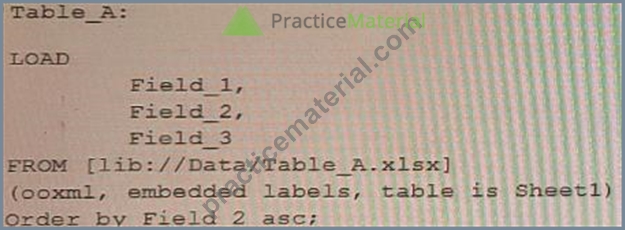
C)
D)
- A. Option B
- B. Option C
- C. Option D
- D. Option A
Answer: C
NEW QUESTION 28
A data architect needs to develop multiple apps for various departments. More departments are requesting apps over time The company uses specific requirements for the number interpretation variables (e.g., ThousandSep, DecimalSep) found at the beginning of a LOAD script.
The data architect wants to reduce duplicate scripts but does not want to copy and paste the number interpretation variables each time new app is created. The data architect prefers to use the least amount of script in Qlik Sense.
How should the data architect meet these requirements?
- A. Save the script for the number interpretation variables in a text file and INLUDE function to insert the variables
- B. Create an Excel file with the number interpretation variables and apply the variables to the app using a mapping table
- C. Create an Excel file with the number interpretation variables and use a FOR Next loop to load the variables into Qlik Sense
- D. Save the script for the number interpretation variables in a text file and use the CALL function to insert the variables.
Answer: A
Explanation:
This method involves saving the script for the number interpretation variables in a separate text file, and then using the INCLUDE function to insert the variables into each new app script that is created. This reduces the need to copy and paste the number interpretation variables each time a new app is created and allows the data architect to use the least amount of script in Qlik Sense.
The INCLUDE function is a script statement that allows you to insert the contents of one script file into another script file. This can be used to insert common scripts, such as the number interpretation variables, into multiple app scripts.
NEW QUESTION 29
Refer to the exhibit.
On executing a load script of an app, the country field needs to be normalized. The developer uses a mapping table to address the issue.
What should the data architect do?
- A. Create two different mapping tables
- B. Use LOAD DISTINCT on the mapping table
- C. Use a LEFT JOIN instead of the APPLYMAP
- D. Review the values of the source mapping table
Answer: D
NEW QUESTION 30
A global retailer has a large database in which millions of sales transactions are added per hour.
Each regional sales manager should only see details for customers in their region. After filtering based on criteria such as region, gender, and income level, sales managers should be able to see the most current detailed transactions.
What should a data architect do to meet these requirements?
- A. Create an app for each sales manager with Qlik GeoAnalytics
- B. Use section access to restrict sales manager access by region
- C. Use section access and include a service account in the table
- D. Use On-Demand App Generation (ODAG) and section access
Answer: B
NEW QUESTION 31
A data architect needs to revise an existing app.
The number of data rows has grown rapidly recently. While the app is in production, users are becoming increasingly unhappy about the response times when they make selections Which two methods should be used to improve performance? (Select two.)
- A. Denormalize the schema
- B. Make sure any Ul variables are preceded by '='
- C. Use dynamic script generation with variables
- D. Create master items for all complex expressions
- E. Use flags in the data model to simplify set analysis
Answer: C,E
NEW QUESTION 32
A data architect of an organization that has implemented Qlik Sense on Windows needs to load large amounts of data from a database that is continuously updated New records are added, and existing records get updated and deleted. Each record has a LastModified field.
All existing records are exported into a QVD file. The data architect wants to load the records into Qlik Sense efficiently.
Which steps should the data architect take to meet these requirements?
- A. 1 Load the new and updated data from the database.
2. Load the existing data from the QVD without the updated rows that have just been loaded from the database and concatenate with the new and updated records.
3. Load all records from the key field from the database and use an INNER JOIN on the previous table. - B. 1. Load the existing data from the QVD
2. Load new and updated data from the database Concatenate with the table loaded from the QVD.
3. Create a separate table for the deleted rows and use a WHERE NOT EXISTS to remove these records - C. 1 Load the existing data from the QVD
2. Load the new and updated data from the database without the rows that have just been loaded from the QVD and concatenate with data from the QVD
3. Load all records from the key field from the database and use an INNER JOIN on the previous table - D. 1. Use a partial LOAD to load new and updated data from the database.
2. Load the existing data from the QVD without the updated rows that have just been loaded from the database and concatenate with the new and updated records
3. Use the PEEK function to remove the deleted rows
Answer: A
NEW QUESTION 33
Refer to the exhibit.
A data architect is loading the tables and a synth key is generated.
How should the data architect resolve the synthetic key?
- A. Remove the LineNo field from Shipments and use the AutoNumber function on the
- B. Remove the LineNo field from both tables and use the AutoNumber function on the OrderlC field
- C. Create a composite key using OrderlD and LineNo. and remove OrderlD and LineNo from Shipments
- D. Create a composite key using OrdertD and LineNo
Answer: C
NEW QUESTION 34
Refer to the exhibit.
A data architect needs to modify the script to ONLY load rows from Table_B when Field_1 and Field_2 are the same as in Table_A.
(For example, only the row containing A, 1, 456 should be loaded from Table_B.)
Which script should the data architect use?
- A.

- B.

- C.

- D.

Answer: B
NEW QUESTION 35
Refer to the exhibit.
A company has different departments. Executive and Sales should always be the first values in a Department filter pane. Which script must the data architect use to meet this requirement?
A)
B)
C)
D)
- A. Option B
- B. Option C
- C. Option D
- D. Option A
Answer: C
NEW QUESTION 36
A data architect executes the following script.
Which values does the OrderDate field contain after executing the script?
- A. 20210131,2020/01/31,31/01/2019
- B. 20210131, 2020/01/31, 31/01/2019, 0
- C. 20210131, 2020/01/31, 31/01/2019, 31/12/20
- D. 20210131, 2020/01/31, 31/01/2019, 9999
Answer: C
NEW QUESTION 37
A data architect executes the following script:
What will be the result of Table A?
A)
B)
C)
D)
- A. Option B
- B. Option C
- C. Option D
- D. Option A
Answer: C
NEW QUESTION 38
Refer to the exhibits.
While debugging an app, a developer loads data from an application layer QVD file.
In the process of separating a concatenated key into two parts, some split results are missing data What should the data architect do?
1. Utilize a combination of LEFT(), MID(), and RIGHT() functions to capture the key components
2. In the SUBFIELD function, replace the '_' with a '|' or '_' character.
While debugging an app, a developer loads data from an application layer QVD file.
In the process of separating a concatenated key into two parts, some split results are missing data What should the data architect do?
- A. Wrap an IF() function around the SUBFIELDQ functions to check and adapt to null values character
- B. Utilize a combination of LEFT(), MID(), and RIGHTO functions to capture the key components
- C. Instruct the developer of the QVD file to correct the generation of the ConcatKeyAlpha field
- D. Instruct the developer of the QVD file to correct the generation of the ConcatKeyAlpha field
- E. Wrap an IF() function around the SUBFIELD() functions to check and adapt to null values
- F. In the SUBFIELD function, replace the '- with a '|' or '-' character
Answer: A
NEW QUESTION 39
A data architect needs to efficiently prepare a data model for a meeting in an hour.
The data source to be used contains five date fields The app needs to display sales trends and compare the current year to date (CYTD) to last year to date (LYTD) The app is NOT going to be published It will only be used for this meeting and a single user's ad-hoc analysis.
What should the data architect do to meet these requirements?
- A. Use the data manager
- B. Create five master calendars
- C. Load a calendar island
- D. Create a canonical calendar
Answer: D
NEW QUESTION 40
The Marketing department is using some similar KPIs in different apps that need to be modified frequently according to the business needs. The KPIs are created using master items with the same expression.
Which method should the data architect use to manage the modifications in all apps?
- A. Create a core app with all the master items needed and use a BINARY load in the other apps.
- B. Create a selection app with all the master items and use an on-demand app generation method.
- C. Create only a single app with all the master items needed and protect it with SECTION ACCESS.
- D. Create a variable repository and load them using INCLUDE statements in the apps where needed
Answer: D
Explanation:
This method allows the data architect to store the KPIs in a single repository and then use INCLUDE statements to load them into the other apps. This makes it easy to modify the KPIs in one place and have the changes reflected in all the apps. Source: Qlik A variable repository is a central location where all of the master items used in the apps can be stored and managed. By creating a variable repository and loading the master items into each app using INCLUDE statements, the data architect can make modifications to the master items in one place, and the changes will be automatically propagated to all of the apps that use the master items.
This method allows for easy management of the master items and eliminates the need to make changes to each app individually, which can be time-consuming and prone to errors.
NEW QUESTION 41
A data architect needs to add the UnitCost field from the ProductCost table in the Dim_Products Table.
Which script code should the data architect use?
- A.

- B.

- C.

- D.

Answer: A
NEW QUESTION 42
Refer to the exhibit.
A data architect is creating an app using three tables. After executing the script, a warning displays Which two steps should the data architect do to resolve this warning? (Select two.)
- A. Move the preceding Load statement in line 10 between table name (line 23) and Load statement (line 24).
- B. Remove the rename statement (line 24) in the ProductPriceList table leaving the Product field name as is.
- C. insert "Join (ProductDetails)" in front of the Load statement in line 24 to combine ProductPriceList with ProductDetails
- D. Rename the Category field in the ProductPriceLis table to PnceCategory (line 24).
Answer: D
NEW QUESTION 43
Refer to the exhibit.
A Human Resources Director needs an app to analyze organizational structure. The Directory is particularly interested in the longest levels of line management.
Two table loads are required. Both use the same basic structure.
Which two table load prefixes are needed?
- A. * HierarchyBelongs.To(EmployeeID, ManagerlD, Name ManagerlD, Manager, Depth)
- B. * Hierarchy(EmployeelD. ManagerlD Name, Manager Name, Structure V, Depth)
* HierarchyLevelEmployeelD, ManagerlD, Name, Manager, Name, Structure, Depth '/') - C. * HierarchyBelongsTo(ManagerlD, Manager, ManagerlD, ManagerlD, Manager Level)
* Hierarchy(EmployeelD, ManagerlD, Name. Manager Name, Structure '/' Depth) - D. * HierarchyLevel(EmployeelD, ManagerlD Name Level, '/', Structure)
* HierarchyBelongsTo(EmployeelD, ManagerlD, Name ManagerlD, Manager, Depth)
Answer: A
NEW QUESTION 44
Multiple department fields in a dataset require a description
A data architect needs to add the department descriptions or a default value when the department does NOT have a description Which strategy should the data architect use to meet these requirements?
- A. Left Join between tables and Description xlsx in every Department table
- B. ApplyMap with two parameters after the Mapping load
- C. ApplyMap with three parameters after the Mapping load
- D. Enter "Missing description" in the blank rows for Description xlsx then Mapping Load
Answer: C
Explanation:
This strategy involves using the ApplyMap function with three parameters after the Mapping load. This will allow the data architect to add the department descriptions or a default value when the department does not have a description. Source: Qlik
NEW QUESTION 45
A company has a stream with multiple apps One of the apps is a multi-regional sales app.
A data architect must set up security for users to access the stream, enter the app, and view specific sheets and data.
Which features should the data architect use to meet these requirements?
- A. QMC security rules and section access
- B. QMC security rules and custom properties
- C. Section access and set analysis
- D. Section access and sheet properties
Answer: A
NEW QUESTION 46
......
Qlik QSDA2021 Exam Syllabus Topics:
| Topic | Details |
|---|---|
| Topic 1 |
|
| Topic 2 |
|
| Topic 3 |
|
| Topic 4 |
|
| Topic 5 |
|
| Topic 6 |
|
| Topic 7 |
|
| Topic 8 |
|
PDF Download Qlik Test To Gain Brilliante Result!: https://www.practicematerial.com/QSDA2021-exam-materials.html
Provide Updated Qlik QSDA2021 Dumps as Practice Test and PDF: https://drive.google.com/open?id=12h-xTTmGk-NoU1Io448JG8LrZFrK4pGa
