

[Jan-2024] Latest Juniper JN0-649 Certification Practice Test Questions
Verified JN0-649 Dumps Q&As - 1 Year Free & Quickly Updates
NEW QUESTION # 31
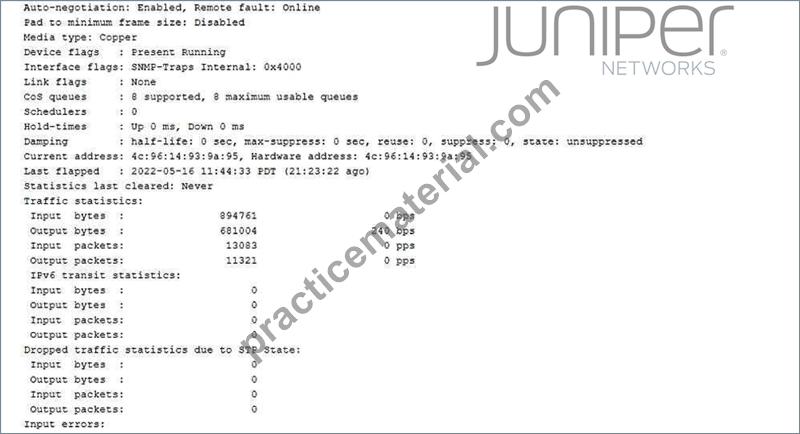
You are asked to troubleshoot voice quality issues on your newly implement VoIP network. You notice that the voice packets are being dropped. You have verified that the packets are correctly marked for expedited forwarding queue.
Referring to the exhibit, what must you configure to solve the problem?
You are asked to troubleshoot voice quality issues on your newly implement VoIP network. You notice that the voice packets are being dropped. You have verified that the packets are correctly marked for expedited forwarding queue.
Referring to the exhibit, what must you configure to solve the problem?


- A. You must configure a multifield classifier to put the VoIP traffic in the correct queue.
- B. You must configure a scheduler to allocate bandwidth to the expedited forwarding queue.
- C. You must configure a policer to ensure that the queue is not being starved.
- D. You must configure a rewrite rule to ensure that the traffic is scheduled properly in the device.
Answer: B
NEW QUESTION # 32
You are troubleshooting connectivity between an EVPN spine switch configured as a route reflector and a leaf node with an IP address of 10.30.100.6.
Referring to the exhibit, what is the problem?
- A. The neighbor 10.30.100.3 statement is missing from leaf1's configuration.
- B. The leaf node is not configured for the family evpn NLRI.
- C. The spine node is not configured for the family inet NLRI.
- D. The neighbor 10.30.100.6 statement is missing from spine1's configuration.
Answer: C
NEW QUESTION # 33
You are configuring BGP policies for a site with a dual-homed connection as shown In the exhibit.
You need all outbound traffic to egress the network through the link to ISP B by default. The ISPs should not be able to override this behavior through BGP attributes.
Which BGP attribute would you modify on the ISP-received routes to accomplish this objective?
- A. next-hop
- B. local preference
- C. MED
- D. origin
Answer: B
NEW QUESTION # 34
You enable the Multiple VLAN Registration Protocol (MVRP) to automate the creation and management of virtual LANs.
Which statement is correct in this scenario?
- A. MVRP works with RSTP and VSTP.
- B. When enabled, MVRP affects all interfaces.
- C. The forbidden mode does not register or declare VLANs.
- D. Timers dictate when link state changes are propagated.
Answer: B
NEW QUESTION # 35
Referring to the log shown in the exhibit, what is the problem with the OSPF adjacency establishment?
- A. The OSPF database description packet is malformed.
- B. There is an MDS authentication mismatch.
- C. The interface IP addresses on the subnet are duplicates.
- D. The referenced IP address does not exist on the network segment.
Answer: C
NEW QUESTION # 36
You have deployed sparce-mode multicast in your network using the IGP metrics shown in the exhibit.
Which path will (*, G) traffic follow form the source to the receiver before the (S, G) state is registered?
- A. Source, R1, R2, R3, R6, Receiver
- B. Source, R1, R2, R5, R2, R3, R6 Receiver
- C. Source, R1, R4, R5, R6, Receiver
- D. Source, R1, R2, R5, R6, Receiver
Answer: B
NEW QUESTION # 37
Which statement is correct about MSTP?
- A. MSTP uses slacked VLAN tags to extend a Layer 2 Ethernet connection between multiple sites
- B. MSTP dynamically manages VLAN registration in a LAN
- C. MSTP enables dynamic discovery of Layer 2 neighbors.
- D. MSTP enables mapping multiple independent spanning tree instances onto one physical topology
Answer: D
NEW QUESTION # 38
You have configured MSTP in your Layer 2 network.
You are having problems with it establishing correctly.
Referring to the exhibit, what is causing the problem?
- A. The region name is not correct
- B. The revision number is the same on both devices
- C. You must assign a context ID number other than zero
- D. The MSTI-to-VLAN mapping does not match
Answer: D
NEW QUESTION # 39
You must provide network connectivity to hosts that fail authentication. In this scenario, what would be used in a network secured with 802.1X to satisfy this requirement?
- A. Configure the native-vlan-id parameter on the port.
- B. Use the server-reject-vlan command to specify a guest VLAN.
- C. Configure the port as a spanning tree edge port.
- D. Configure a secondary IP address on the port for unauthenticated hosts.
Answer: B
NEW QUESTION # 40
A customer requires that the switch responds to an ARP request only if the source and target IP address are on different subnets.
Referring to the Exhibit, how would you accomplish this task?
- A. Enable the no-gratuitous-arp request command under the interface hierarchy.
- B. Remove the proxy ARP setting and clear the entry.
- C. Create a static ARP entry for the host.
- D. Change the proxy ARP parameter setting to restricted.
Answer: D
NEW QUESTION # 41
Click the exhibit.
Where is the policy shown in the exhibit enforced?
- A. Between the BGP peer and the RIB-In table
- B. Between the RIB-LOCAL and the RIB-OUT tables
- C. Between the RIB-OUT table and the BGP peer
- D. Between the RIB-IN and the RIB-LOCAL tables
Answer: D
NEW QUESTION # 42
You are implementing the route summarization feature of OSPF.
Which two results do you achieve in this scenario? (Choose two.)
- A. It reduces the impact of topology changes on a device.
- B. It reduced the routing table size, enabling devices to store and process less information.
- C. It provides optimal routing in the network.
- D. It helps in migrating to future multi-area OSPF network designs.
Answer: A,B
Explanation:
OSPF inter-area route summarization reduces the routing information exchanged between areas and the size of routing tables, and improves routing performance. OSPF inter-area route summarization enables an ABR to summarize contiguous networks into a single network and advertise the network to other areas.
NEW QUESTION # 43
Your enterprise network is running BGP VPNs to support multitenancy. Some of the devices with which you peer BGP do not support the VPN NLRI. You must ensure that you do not send BGP VPN routes to the remote peer.
Which two configuration steps will satisfy this requirement? (Choose two.)
- A. Configure the apply-vpn-export feature on the local BGP peer.
- B. Configure an import policy on the remote peer to reject the routes when they are received.
- C. Configure a route reflector for the VPN NLRI.
- D. Configure an export policy on the local BGP peer to reject the VPN routes being sent to the remote peer.
Answer: A,D
NEW QUESTION # 44
You are troubleshooting a route problem in the topology shown in the exhibit. The 10.30.0 0/24 route is not reachable from the R3 router. What would cause this problem?
- A. R3 does not have an OSPF route for 10.30.0.0/24
- B. R3 does not have an established BGP session with R4.
- C. R4 is not advertising the 10.30.0.0/24 route to R3
- D. R3 does not have a route to the BGP next hop of 10.30.0.0/24
Answer: D
NEW QUESTION # 45
You are configuring an EVPN overlay to allow VLANs to be stretched between two campus sites, but EVPN routes are not being exchanged. Referring to the exhibit, which configuration statement would solve this problem?
- A. Apply the delete protocols bgp group EVPN multipath multiple-an configuration on MX1 and MX2
- B. Apply the set protocols bgp group EVPN family inet-vpn any configuration on MX1 and MX?
- C. Apply the delete protocols bgp group EVPN cluster 172 .1.1. 53 configuration on MX2
- D. Apply the set protocols bgp group EVPN family EVPN signaling configuration on MX2.
Answer: D
NEW QUESTION # 46
Which EVPN route type is used for fast convergence and for advertising the split horizon label?
- A. Type 2
- B. Type 4
- C. Type 5
- D. Type 1
Answer: D
NEW QUESTION # 47
Referring to the exhibit, which two statements are correct? (Choose two.)
- A. The DS-1 switch will be root bridge for MSTI 2.
- B. The DS-2 switch will be root bridge for MSTI 2.
- C. The DS-1 switch will be root bridge for MSTI 1.
- D. The DS-2 switch will be root bridge for MSTI 1.
Answer: B,D
NEW QUESTION # 48
Which three MSTP parameters must match on all switches in the same MST region? (Choose three.)
- A. MSTI-to-VLAN mapping
- B. bridge priority
- C. forwarding delay
- D. configuration name
- E. revision number
Answer: A,D,E
Explanation:
https://www.juniper.net/documentation/us/en/software/junos/stp-l2/topics/topic-map/spanning-tree-configuring-mstp.html
NEW QUESTION # 49
Referring to the outputs shown in the exhibit, which two statements are correct about the IS-IS adjacency? (Choose two.)
- A. R2 is configured to participate in both Level 1 and Level 2.
- B. R2 is configured to participate in Level 2 only.
- C. R1 is configured to participate in Level 2 only.
- D. R1 is configured to participate in both Level 1 and Level 2.
Answer: A,C
NEW QUESTION # 50
......
Latest 2024 Realistic Verified JN0-649 Dumps - 100% Free JN0-649 Exam Dumps: https://www.practicematerial.com/JN0-649-exam-materials.html
Get 2024 Updated Free Juniper JN0-649 Exam Questions and Answer: https://drive.google.com/open?id=1hXVvX3eytOUE8F_ene6vEDm3EbV6WN_2
