

Pass Microsoft DP-300 exam questions - convert Test Engine to PDF
Pass Your DP-300 Exam Easily - Real DP-300 Practice Dump Updated Jul 12, 2024
NEW QUESTION # 187
You have an Azure SQL database named DB1 that contains two tables named Table1 and Table2. Both tables contain a column named a Column1. Column1 is used for joins by an application named App1.
You need to protect the contents of Column1 at rest, in transit, and in use.
How should you protect the contents of Column1? To answer, select the appropriate options in the answer area.
NOTE:Each correct selection is worth one point.
Answer:
Explanation:
Explanation
Box 1: Column encryption Key
Always Encrypted uses two types of keys: column encryption keys and column master keys. A column encryption key is used to encrypt data in an encrypted column. A column master key is a key-protecting key that encrypts one or more column encryption keys.
Reference:
https://docs.microsoft.com/en-us/sql/relational-databases/security/encryption/always-encrypted-database-engine
NEW QUESTION # 188
Hotspot Question
You have a SQL Server on Azure Virtual Machines instance named VM1 that hosts a database named DB1.
You run the following query.
For each of the following statements, select Yes if the statement is true. Otherwise, select No.
NOTE: Each correct selection is worth one point.
Answer:
Explanation:
Explanation:
Box 1: No
A copy-only log backup preserves the existing log archive point and, therefore, does not affect the sequencing of regular log backups.
Box 2: No
Box 3: Yes
If the database is online and you plan to perform a restore operation on the database, begin by backing up the tail of the log. To avoid an error for an online database, you must use the ... WITH NORECOVERY option of the BACKUP Transact-SQL statement.
Reference:
https://docs.microsoft.com/en-us/sql/relational-databases/backup-restore/tail-log-backups-sql-server
https://docs.microsoft.com/en-us/sql/relational-databases/backup-restore/copy-only-backups-sql-server
NEW QUESTION # 189
You create a new Azure SQL managed instance named SQL1 and enable Database Mail extended stored You need to ensure that SQ Server Agent jobs running on SQL 1 can notify when a failure Occurs Which three actions should you perform in sequence 7 TO answer. move the appropriate actions from the list Of actions to answer area and arrange them in correct order.
Answer:
Explanation:
Explanation:
NEW QUESTION # 190
You have a Microsoft SQL Server database named DB1 that contains a table named Table1.
The database role membership for a user named User1 is shown in the following exhibit.
Use the drop-down menus to select the answer choice that completes each statement based on the information presented in the graphic.
NOTE: Each correct selection is worth one point.
Answer:
Explanation:
Reference:
https://docs.microsoft.com/en-us/sql/relational-databases/security/authentication-access/database-level-roles
NEW QUESTION # 191
You have a new Azure SQL database named DB1 on an Azure SQL server named AzSQL1.
The only user who was created is the server administrator.
You need to create a contained database user in DB1 who will use Azure Active Directory (Azure AD) for authentication.
Which three actions should you perform in sequence? To answer, move the appropriate actions from the list of actions to the answer area and arrange them in the correct order.
Answer:
Explanation:
1 - Set up the Active Directory Admin for AzSQL1.
2 - Connect to DB1 by using the Active Directory admin account.
3 - Create a user by using the FROM EXTERNAL PROVIDER clause.
Reference:
https://docs.microsoft.com/en-us/sql/t-sql/statements/create-user-transact-sql
NEW QUESTION # 192
Note: This question is part of a series of questions that present the same scenario. Each question in the series contains a unique solution that might meet the stated goals. Some question sets might have more than one correct solution, while others might not have a correct solution.
After you answer a question in this section, you will NOT be able to return to it. As a result, these questions will not appear in the review screen.
You have an Azure Data Lake Storage account that contains a staging zone.
You need to design a daily process to ingest incremental data from the staging zone, transform the data by executing an R script, and then insert the transformed data into a data warehouse in Azure Synapse Analytics.
Solution: You use an Azure Data Factory schedule trigger to execute a pipeline that executes an Azure Databricks notebook, and then inserts the data into the data warehouse.
Does this meet the goal?
- A. Yes
- B. No
Answer: B
Explanation:
Section: [none]
Explanation:
If you need to transform data in a way that is not supported by Data Factory, you can create a custom activity, not an Azure Databricks notebook, with your own data processing logic and use the activity in the pipeline. You can create a custom activity to run R scripts on your HDInsight cluster with R installed.
Reference:
https://docs.microsoft.com/en-US/azure/data-factory/transform-data
NEW QUESTION # 193
You have an Azure subscription.
You plan to deploy a new Azure virtual machine that will host a Microsoft SQL Server instance.
You need to configure the disks on the virtual machine. The solution must meet the following requirements:
* Minimize latency for transaction logs.
* Minimize the impact on IO Of the virtual machine.
Which type of disk should you use for each workload? To answer. drag the appropriate disk types to the correct workloads. Each disk type may be used once, at all. You may need to drag the split bar between panes or scroll to view content.
NOTE: Each correct selection is worth one point.
Answer:
Explanation:
NEW QUESTION # 194
You have an Azure SQL database named DB1. The automatic tuning options for DB1 are configured as shown in the following exhibit.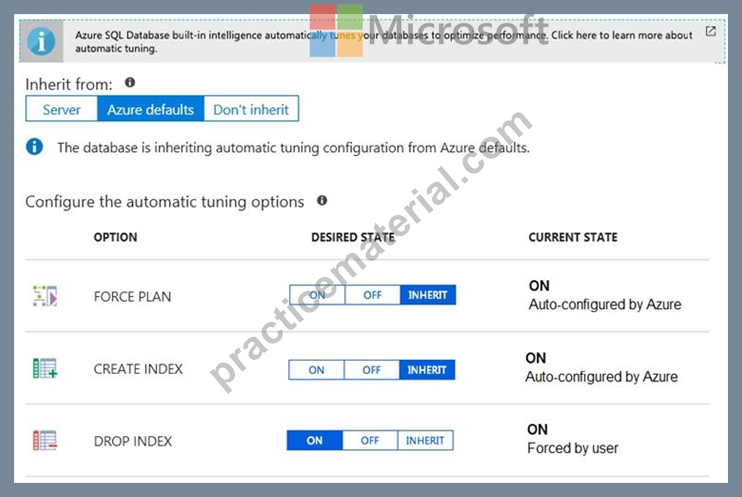
For each of the following statements, select Yes if the statement is true. Otherwise, select No.
NOTE: Each correct selection is worth one point.
Answer:
Explanation: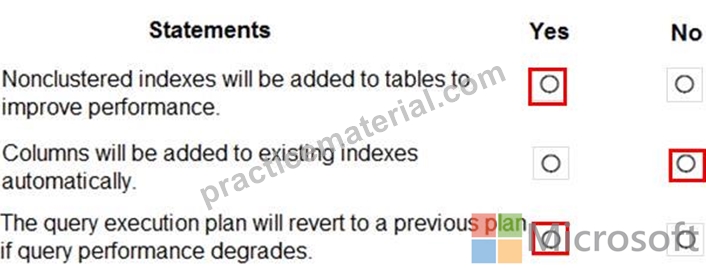
NEW QUESTION # 195
You are performing exploratory analysis of bus fare data in an Azure Data Lake Storage Gen2 account by using an Azure Synapse Analytics serverless SQL pool.
You execute the Transact-SQL query shown in the following exhibit.
Use the drop-down menus to select the answer choice that completes each statement based on the information presented in the graphic.
Answer:
Explanation:
Reference:
https://docs.microsoft.com/en-us/azure/synapse-analytics/sql/develop-openrowset
NEW QUESTION # 196
Which windowing function should you use to perform the streaming aggregation of the sales data?
- A. Session
- B. Tumbling
- C. Sliding
- D. Hopping
Answer: B
Explanation:
Explanation
Scenario: The sales data, including the documents in JSON format, must be gathered as it arrives and analyzed online by using Azure Stream Analytics. The analytics process will perform aggregations that must be done continuously, without gaps, and without overlapping.
Tumbling window functions are used to segment a data stream into distinct time segments and perform a function against them, such as the example below. The key differentiators of a Tumbling window are that they repeat, do not overlap, and an event cannot belong to more than one tumbling window.
Timeline Description automatically generated
Reference:
https://github.com/MicrosoftDocs/azure-docs/blob/master/articles/stream-analytics/stream-analytics-window-fun
NEW QUESTION # 197
You have a new Azure SQL database named DB1 on an Azure SQL server named AzSQL1.
The only user who was created is the server administrator.
You need to create a contained database user in DB1 who will use Azure Active Directory (Azure AD) for authentication.
Which three actions should you perform in sequence? To answer, move the appropriate actions from the list of actions to the answer area and arrange them in the correct order.
Answer:
Explanation:
Explanation
Step 1: Set up the Active Directory Admin for AzSQL1.
Step 2: Connect to DB1 by using the server administrator.
Sign into your managed instance with an Azure AD login granted with the sysadmin role.
Step 3: Create a user by using the FROM EXTERNAL PROVIDER clause.
FROM EXTERNAL PROVIDER is available for creating server-level Azure AD logins in SQL Database managed instance. Azure AD logins allow database-level Azure AD principals to be mapped to server-level Azure AD logins. To create an Azure AD user from an Azure AD login use the following syntax:
CREATE USER [AAD_principal] FROM LOGIN [Azure AD login]
Reference:
https://docs.microsoft.com/en-us/sql/t-sql/statements/create-user-transact-sql
NEW QUESTION # 198
You have a SQL Server on Azure Virtual Machines instance named VM1 that hosts a database named DB1. You run the following query.
For each of the following statements, select Yes if the statement is true. Otherwise, select No.
Answer:
Explanation:
NEW QUESTION # 199
You have an Azure subscription that contains a logical SQL server. The server hosts two databases named db1 and db2 and an Azure AD sen/ice principal named appl.
You need to ensure that appl can access db1. The solution must use the principle of least privilege.
How should you complete the Transact-SQL statement? To answer, select the appropriate options in the answer area.
NOTE: Each correct selection is worth one point.
Answer:
Explanation:
Explanation
NEW QUESTION # 200
You have an Azure subscription that contains the resources shown in the following table.
You need to configure a connection between VM1 and MIL The solution must meet the following requirements:
* The connection must be encrypted.
* Network latency must be minimized.
What should you implement?
- A. private endpoints
- B. service endpoints
- C. virtual network peering
- D. a site-to-site VPN
Answer: A
NEW QUESTION # 201
You have SQL Server on an Azure virtual machine that contains a database named DB1. DB1 contains a table named CustomerPII.
You need to record whenever users query the CustomerPII table.
Which two options should you enable? Each correct answer presents part of the solution.
NOTE: Each correct selection is worth one point.
- A. SQL Server audit
- B. server audit specification
- C. database audit specification
- D. a server principal
Answer: B,C
Explanation:
Explanation
An auditing policy can be defined for a specific database or as a default server policy in Azure (which hosts SQL Database or Azure Synapse):
* A server policy applies to all existing and newly created databases on the server.
* If server auditing is enabled, it always applies to the database. The database will be audited, regardless of the database auditing settings.
* Enabling auditing on the database, in addition to enabling it on the server, does not override or change any of the settings of the server auditing. Both audits will exist side by side.
Note:
The Server Audit Specification object belongs to an audit.
A Database Audit Specification defines which Audit Action Groups will be audited for the specific database in which the specification is created.
Reference:
https://docs.microsoft.com/en-us/azure/azure-sql/database/auditing-overview
NEW QUESTION # 202
You have an Azure Synapse Analytics dedicated SQL pool named Pool1 and an Azure Data Lake Storage Gen2 account named Account1.
You plan to access the files in Account1 by using an external table.
You need to create a data source in Pool1 that you can reference when you create the external table.
How should you complete the Transact-SQL statement? To answer, select the appropriate options in the answer area.
NOTE: Each correct selection is worth one point.
Answer:
Explanation:
Explanation
Graphical user interface, table Description automatically generated
Box 1: blob
The following example creates an external data source for Azure Data Lake Gen2 CREATE EXTERNAL DATA SOURCE YellowTaxi WITH ( LOCATION = 'https://azureopendatastorage.blob.core.windows.net/nyctlc/yellow/', TYPE = HADOOP) Box 2: HADOOP Reference:
https://docs.microsoft.com/en-us/azure/synapse-analytics/sql/develop-tables-external-tables
NEW QUESTION # 203
You have a Microsoft SQL Server database named DB1 that contains a table named Table1.
The database role membership for a user named User1 is shown in the following exhibit.
Use the drop-down menus to select the answer choice that completes each statement based on the information presented in the graphic.
NOTE: Each correct selection is worth one point.
Answer:
Explanation:
Explanation
Box 1: delete a row from Table1
Members of the db_datawriter fixed database role can add, delete, or change data in all user tables.
Box 2: db_datareader
Members of the db_datareader fixed database role can read all data from all user tables.
Reference:
https://docs.microsoft.com/en-us/sql/relational-databases/security/authentication-access/database-level-roles
NEW QUESTION # 204
You have an Azure SQL Database instance named DatabaseA on a server named Server1.
You plan to add a new user named App1 to DatabaseA and grant App1 db_datacenter permissions. App1 will use SQL Server Authentication.
You need to create App1. The solution must ensure that App1 can be given access to other databases by using the same credentials.
Which three actions should you perform in sequence? To answer, move the appropriate actions from the list of actions to the answer area and arrange them in the correct order.
Answer:
Explanation:
Explanation:
Step 1: On the master database, run CREATE LOGIN [App1] WITH PASSWORD = 'p@aaW0rd!' Logins are server wide login and password pairs, where the login has the same password across all databases.
Here is some sample Transact-SQL that creates a login:
CREATE LOGIN readonlylogin WITH password='1231!#ASDF!a';
You must be connected to the master database on SQL Azure with the administrative login (which you get from the SQL Azure portal) to execute the CREATE LOGIN command.
Step 2: On DatabaseA, run CREATE USER [App1] FROM LOGIN [App1]
Users are created per database and are associated with logins. You must be connected to the database in where you want to create the user. In most cases, this is not the master database. Here is some sample Transact-SQL that creates a user:
CREATE USER readonlyuser FROM LOGIN readonlylogin;
Step 3: On DatabaseA run ALTER ROLE db_datareader ADD Member [App1]
Just creating the user does not give them permissions to the database. You have to grant them access. In the Transact-SQL example below the readonlyuser is given read only permissions to the database via the db_datareader role.
EXEC sp_addrolemember 'db_datareader', 'readonlyuser';
Reference:
https://azure.microsoft.com/en-us/blog/adding-users-to-your-sql-azure-database/
NEW QUESTION # 205
You have an Azure Synapse Analytics dedicated SQL pool.
You run PDW_SHOWSPACEUSED('dbo.FactInternetSales'); and get the results shown in the following table.
Which statement accurately describes the dbo.FactInternetSales table?
- A. The table is skewed.
- B. All distributions contain data.
- C. The table uses round-robin distribution
- D. The table contains less than 10,000 rows.
Answer: A
Explanation:
The rows per distribution can vary up to 10% without a noticeable impact on performance. Here the distribution varies more than 10%. It is skewed.
Note: SHOWSPACEUSED displays the number of rows, disk space reserved, and disk space used for a specific table, or for all tables in a Azure Synapse Analytics or Parallel Data Warehouse database.
This is a very quick and simple way to see the number of table rows that are stored in each of the 60 distributions of your database. Remember that for the most balanced performance, the rows in your distributed table should be spread evenly across all the distributions.
ROUND_ROBIN distributed tables should not be skewed. Data is distributed evenly across the nodes by design.
Reference:
https://docs.microsoft.com/en-us/azure/synapse-analytics/sql-data-warehouse/sql-data-warehouse-tables-distribu
https://github.com/rgl/azure-content/blob/master/articles/sql-data-warehouse/sql-data-warehouse-manage-distrib
NEW QUESTION # 206
You need to design an analytical storage solution for the transactional data. The solution must meet the sales transaction dataset requirements.
What should you include in the solution? To answer, select the appropriate options in the answer area.
NOTE: Each correct selection is worth one point.
Answer:
Explanation:
Explanation
Graphical user interface, text, application Description automatically generated
Box 1: Hash
Scenario:
Ensure that queries joining and filtering sales transaction records based on product ID complete as quickly as possible.
A hash distributed table can deliver the highest query performance for joins and aggregations on large tables.
Box 2: Round-robin
Scenario:
You plan to create a promotional table that will contain a promotion ID. The promotion ID will be associated to a specific product. The product will be identified by a product ID. The table will be approximately 5 GB.
A round-robin table is the most straightforward table to create and delivers fast performance when used as a staging table for loads. These are some scenarios where you should choose Round robin distribution:
When you cannot identify a single key to distribute your data.
If your data doesn't frequently join with data from other tables.
When there are no obvious keys to join.
Reference:
https://rajanieshkaushikk.com/2020/09/09/how-to-choose-right-data-distribution-strategy-for-azure-synapse/
NEW QUESTION # 207
......
The DP-300 certification exam covers a wide range of topics such as designing and implementing database solutions on Azure, managing and monitoring databases, implementing security and high availability, and optimizing database performance. DP-300 exam also focuses on advanced topics such as Azure SQL Database Managed Instance, Azure SQL Data Warehouse, and Azure Cosmos DB.
DP-300 Real Exam Questions and Answers FREE: https://www.practicematerial.com/DP-300-exam-materials.html
2024 Realistic Verified Free Microsoft DP-300 Exam Questions: https://drive.google.com/open?id=15fewjrHY6PnnhPbSFtZpu_ZonM2tcL_o
