

Latest The Open Group OGBA-101 First Attempt, Exam real Dumps Updated [Nov-2023]
Get the superior quality OGBA-101 Dumps Questions from PracticeMaterial. Nobody can stop you from getting to your dreams now. Your bright future is just a click away!
NEW QUESTION # 12
Which of the following best describes a TOGAF business scenario?
- A. A method to develop a business model.
- B. A technique to elaborate an architecture effort.
- C. A use-case providing detailed descriptions.
- D. A business case.
Answer: B
Explanation:
A TOGAF business scenario is a technique that can be used to fully understand the requirements of information technology and align it with business needs1. It is not a business case, which is a document that provides justification for a proposed project or initiative6. It is not a method to develop a business model, which is a description of how an organization creates, delivers, and captures value for its stakeholders7. It is not a use-case, which is a description of how a system interacts with external actors to achieve a specific goal.
NEW QUESTION # 13
Which of the following is a derived relationship in an organization map?
- A. Location
- B. Capability
- C. Scope of enterprise
- D. Value flow
Answer: D
Explanation:
According to the TOGAF Series Guide: Organization Mapping, one of the derived relationships in an organization map is value flow1. A value flow is a relationship that shows how value is exchanged between business units or other entities in an organization map1. A value flow can be expressed as a verb phrase that indicates what type of value is transferred or shared between entities1. For example, in an organization map for an online retailer, a possible value flow could be "Delivers products" between the Warehouse business unit and the Customer entity.
NEW QUESTION # 14
Which of the following is a benefit of organization mapping?
- A. An organization map highlights inefficiencies and reduces operational costs.
- B. An organization map improves strategic planning.
- C. An organization map improves the ability to consume, process, and deliver information.
- D. An organization map can be reused for training and employee development.
Answer: B
Explanation:
One of the benefits of organization mapping is that it improves strategic planning2. Organization mapping is a technique that can be used to document and visualize the organizational structure and relationships of an enterprise or a part of it2. Organization mapping can help to align the organizational design with the business strategy, goals, and objectives2. Organization mapping can also help to identify the roles, responsibilities, authorities, accountabilities, and dependencies of different organizational entities2. By providing a clear and consistent view of the organizational landscape, organization mapping can enable better informed and more effective decisions for strategic planning.
NEW QUESTION # 15
Which of the following is a benefit of information mapping?
- A. It provides a basis to support decision-making throughout the business.
- B. It provides a framework for effective business requirements analysis.
- C. It enables improved business process integration.
- D. It highlights information requirements not addressed by a business architecture.
Answer: A
Explanation:
One of the benefits of information mapping is that it provides a basis to support decision-making throughout the business1. Information mapping is a technique that can be used to document and visualize the information concepts and their relationships that are relevant for the business1. Information mapping can help to identify the information needs, sources, flows, quality, and value of the business, as well as the gaps, issues, and opportunities for improvement1. By providing a clear and consistent view of the information landscape, information mapping can enable better informed and more effective decisions at all levels of the business.
NEW QUESTION # 16
In what TOGAF ADM phase is the information map linked to other business blueprints?
- A. Phase A
- B. Phase B
- C. Phase E
- D. Preliminary Phase
Answer: C
Explanation:
Phase E Explanation of Correct answer: In Phase E (Opportunities and Solutions) of the TOGAF Explanation:ADM, the information map is linked to other business blueprints such as the Business Capability Map, the Value Stream Map, and the Business Process Model Phase E Explanation of Correct answer: In Phase E (Opportunities and Solutions) of the TOGAF Explanation:ADM, the information map is linked to other business blueprints such as the Business Capability Map, the Value Stream Map, and the Business Process Model2. This helps to identify and prioritize opportunities for business improvement and transformation2.
NEW QUESTION # 17
Which of the following is a difference between an organization map and an organization chart?
- A. An organization map reduces the time, cost, and risk of business operations.
- B. An organization map is limited to formal relationships between business units.
- C. An organization map can be impacted by a business model change.
- D. An organization map highlights where in the organization that stakeholder concerns are not being addressed by a business architecture.
Answer: D
Explanation:
An organization map is a technique that can be used to show how a business architecture addresses stakeholder concerns across different parts of an organization3. It can highlight gaps or overlaps in the coverage of stakeholder concerns by a business architecture. An organization chart, on the other hand, is a diagram that shows the formal structure and hierarchy of an organization, such as reporting relationships and roles4. An organization chart does not necessarily show how stakeholder concerns are addressed by a business architecture.
NEW QUESTION # 18
Which of the following best describes the relationship between business models and business architecture?
- A. Business model development is a prerequisite for a Business Architecture development.
- B. Business Architecture breaks a business model down into the core functional elements that describe how the business works.
- C. Business models are useful for impact analysis, however Business Architecture is needed for scenario analysis.
- D. Business Architecture provides a conceptual summary view, whereas business models support in-depth analysis.
Answer: B
Explanation:
A business model describes how an organization creates, delivers, and captures value for its stakeholders3. A business architecture breaks a business model down into the core functional elements that describe how the business works, such as the value proposition, the customer segments, the channels, the revenue streams, the cost structure, the key resources, the key activities, and the key partnerships3.
NEW QUESTION # 19
Which of the following can be used to help define information concepts in an information map?
- A. Value streams
- B. Statement of business goals and drivers
- C. Stakeholder Map
- D. Organization Map
Answer: A
Explanation:
Value streams can be used to help define information concepts in an information map5. A value stream is a representation of a sequence of activities that create an overall result for a customer, stakeholder, or end user5. A value stream can help to identify the information that is required, produced, consumed, or exchanged by each activity in the value stream. An information map can then document and visualize the information concepts and their relationships.
NEW QUESTION # 20
Consider the diagram.
What are the items labelled A, B and C?
- A. A-Architecture Vision, B-Business Architecture. C-lnformation Systems Architecture
- B. A-Enterprise Architecture, B-Architecture Building Blocks, C-Solutions Building Blocks
- C. A-Enterprise Continuum, B-Architecture Continuum. C-Solutions Continuum
- D. A-Enterprise Strategic Architecture, B-Segment Architecture, C-Solutions Architecture
Answer: C
Explanation:
The diagram shows the Enterprise Continuum, which is a view of the Architecture Repository that provides methods for classifying architecture and solution artifacts as they evolve from generic Foundation Architectures to Organization-Specific Architectures4. The Enterprise Continuum comprises two complementary concepts: the Architecture Continuum and the Solutions Continuum. The Architecture Continuum shows the relationships among foundational frameworks, common system architectures, industry architectures, and enterprise architectures4. The Solutions Continuum shows the relationships among foundational solutions, common system solutions, industry solutions, and enterprise solutions4.
NEW QUESTION # 21
What component of the Architecture Repository is an architectural representation of SBBs supporting the Architecture Landscape?
- A. Solutions Library
- B. Solutions Continuum
- C. Solutions Landscape
- D. Solutions Repository
Answer: C
Explanation:
The component of the Architecture Repository that is an architectural representation of SBBs supporting the Architecture Landscape is the Solutions Landscape3. The Solutions Landscape presents an architectural representation of the Solution Building Blocks (SBBs) that support the Architecture Landscape and have been planned or deployed by the enterprise3. The Solutions Landscape shows how SBBs are mapped to Architecture Building Blocks (ABBs) in different architecture domains and levels3. The Solutions Landscape can help to ensure consistency and alignment between the Architecture Landscape and the solutions that implement it.
NEW QUESTION # 22
Which of the following describes how business models are used within the TOGAF standard?
- A. To identify, classify, and mitigate risks to the business.
- B. To help formulate architecture and business principles.
- C. To document the factors impacting the business migration plan.
- D. To tailor the enterprise architecture for the business.
Answer: B
Explanation:
Business models are used within the TOGAF standard to help formulate architecture and business principles4. A business model describes how an organization creates, delivers, and captures value for its stakeholders4. A business model can help to define the strategic direction, goals, and objectives of the organization, which can then inform the development of architecture and business principles that guide the design and evolution of the enterprise architecture.
NEW QUESTION # 23
Which of the following is a benefit of Value Stream Mapping?
- A. It helps to identify value, duplication, and redundancy across the enterprise.
- B. It helps to assess an organization's effectiveness at creating, capturing, and delivering value for different stakeholders.
- C. It highlights the value of individual work packages needed to develop the business architecture.
- D. It helps to ensure that investments and project initiatives are prioritized and funded at a level matching with their value.
Answer: B
Explanation:
One of the benefits of Value Stream Mapping is that it helps to assess an organization's effectiveness at creating, capturing, and delivering value for different stakeholders2. Value Stream Mapping is a technique that can be used to represent a sequence of activities that create an overall result for a customer, stakeholder, or end user2. Value Stream Mapping can help to identify the value proposition, outcomes, measures, enablers, and dependencies of each activity in the value stream, as well as the overall value flow and performance2. By analyzing the value stream map, the organization can evaluate how well it is meeting the stakeholder needs and expectations, as well as identify opportunities for improvement or innovation.
NEW QUESTION # 24
In business capability mapping, when you have documented all of the business capabilities, what should you do next?
- A. Organize the business capabilities in a logical manner.
- B. Draw up a business value assessment for each of the business capabilities.
- C. Identify the human and computer actors associated with each business capability.
- D. Map the business capabilities to stakeholder concerns.
Answer: A
Explanation:
According to the TOGAF Series Guide: Business Capabilities, after documenting all of the business capabilities, the next step is to organize them in a logical manner1. This can be done by using techniques such as layering, sorting, mapping, and leveling1. These techniques can help to classify, group, and align capabilities into categories for a deeper understanding of how they support the business goals and objectives1. Organizing the business capabilities can also help to identify dependencies, gaps, overlaps, or redundancies among them1.
NEW QUESTION # 25
Which of the following Business Architecture concepts should the architect examine and search for when developing the Architecture Vision?
- A. Organization Map. Business Capabilities
- B. Architecture Continuum, Architecture Repository
- C. Implementation Factor Catalog. Business Value Assessment Matrix
- D. Architecture Principles, Business Goals
Answer: A
Explanation:
According to the TOGAF Standard, when developing the Architecture Vision, the architect should examine and search for business capabilities and organization maps1. Business capabilities are the expression or the articulation of the capacity, materials, and expertise an organization needs in order to perform core functions2. Organization maps are a technique that can be used to show how a business architecture addresses stakeholder concerns across different parts of an organization3. These concepts can help to define the scope and objectives of the architecture project, as well as to identify key stakeholders and their needs.
NEW QUESTION # 26
Consider the following Business Capability Example: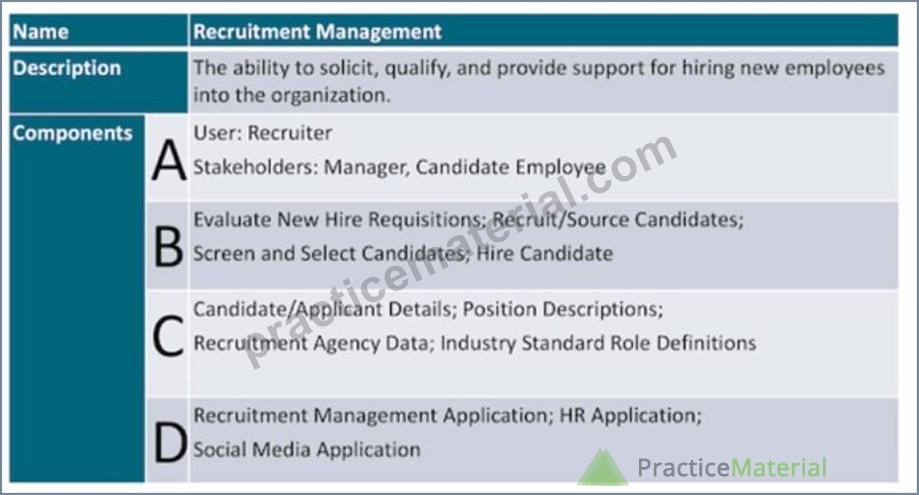
Which of the following are A and C?
- A. Roles, Information.
- B. Organization. Data.
- C. Who. What.
- D. Actors, Actions.
Answer: A
Explanation:
According to the TOGAF Business Capabilities Guide V2, a business capability is defined as "the expression or the articulation of the capacity, materials, and expertise an organization needs in order to perform core functions"5. A business capability can be decomposed into four elements: roles, information, processes, and technology5. In the given example, A represents roles and C represents information.
NEW QUESTION # 27
What is defined as the effect of uncertainty on objectives?
- A. Vulnerability
- B. Threat
- C. Risk
- D. Continuity
Answer: C
Explanation:
Risk is defined as the effect of uncertainty on objectives. It can be positive or negative depending on whether it enhances or hinders the achievement of objectives. Threat is a potential cause of risk that could have a negative impact on objectives. Continuity is the ability to maintain or resume normal operations after a disruption or disaster. Vulnerability is a weakness or exposure that could be exploited by a threat to cause harm or damage.
NEW QUESTION # 28
Which of the following best describes a business capability?
- A. It is an articulation of the relationships between business entities that make up the enterprise.
- B. It is a qualitative statement of intent that should be met by the enterprise architecture capability developing the business architecture.
- C. It is a detailed description of the architectural approach to realize a particular solution.
- D. It delineates what a business does without an explanation of how, why, or where the capability is used.
Answer: D
Explanation:
According to the TOGAF Series Guide to Business Capabilities (Version 2), a business capability is defined as "a particular ability or capacity that a business may possess or exchange to achieve a specific purpose or outcome" 4. A business capability delineates what a business does without an explanation of how, why, or where the capability is used4. A business capability can be expressed as a verb phrase that indicates what function or service the capability provides4. For example, some possible business capabilities are "Manage Customer Relationships", "Deliver Products", or "Perform Financial Analysis".
NEW QUESTION # 29
......
The Open Group Practice Test Engine with OGBA-101 Questions: https://drive.google.com/open?id=1ZlcOLBO4kn69pLhGKevJNmeIvVFj11xn
Guaranteed Success with Valid The Open Group OGBA-101 Dumps: https://www.practicematerial.com/OGBA-101-exam-materials.html
