

Updated Mar-2023 Exam Materials for You to Prepare & Pass MB-500 Exam.
Pass Your MB-500 Exam at the First Try with 100% Real Exam
Target Audience and Prerequisites
One of the first things that you need to know about the Microsoft MB-500 exam is that it is designed for those developers who work with Operations & Finance apps within Microsoft Dynamics 365. There are quite a few skills that the candidates need to develop before attempting this test and some of them are as follows: implementing permission policies & security requirements; creating technical designs as well as implementation details; analyzing and manipulating data; monitoring performance; performing testing; customizing user interfaces; developing business login with the help of X++.
To be eligible for this certification exam, the students also need to have knowledge and experience with data structures & frameworks. In addition, they should be conversant with technologies, such as SQL Server Management Studio, LCS tools, Azure DevOps, and Visual Studio.
NEW QUESTION 56
You create a new class.
Class compilation must fail if a specific method in the source code is called.
You need to mark the class with the appropriate attribute.
Which attribute should you use?
- A. SysTestCategory
- B. SysObsoleteAttribute
- C. SysAppSecurityAttribute
- D. SysAttribute
Answer: B
Explanation:
Reference:
https://docs.microsoft.com/en-us/dynamicsax-2012/developer/overview-of-attribute-classes
NEW QUESTION 57
You are a Dynamics 365 Finance and Operations developer. You create a class.
You need to mark the class to ensure that when code is compiled, the process fails if a specific method is called in the source code.
Which attribute should you use?
- A. SysObsoleteAttribute
- B. getAttributes
- C. SysEntryPointAttribute
- D. SysAttribute
Answer: A
Explanation:
Explanation
Explanation:
One use of the SysObsoleteAttribute class is to notify the compiler that the compile should fail if a particular method is called in the source code. The compiler rejects the compile, and displays the specific message that is stored in this use of the attribute.
Reference:
https://docs.microsoft.com/en-us/dynamics365/fin-ops-core/dev-itpro/dev-ref/xpp-attribute-classes
NEW QUESTION 58
You are a Dynamics 365 Finance and Operations developer. You have the following code: (Line numbers are created for reference only.)
Which values does the info() method return? To answer, select the appropriate option in the answer area.
NOTE: Each correct selection is worth one point.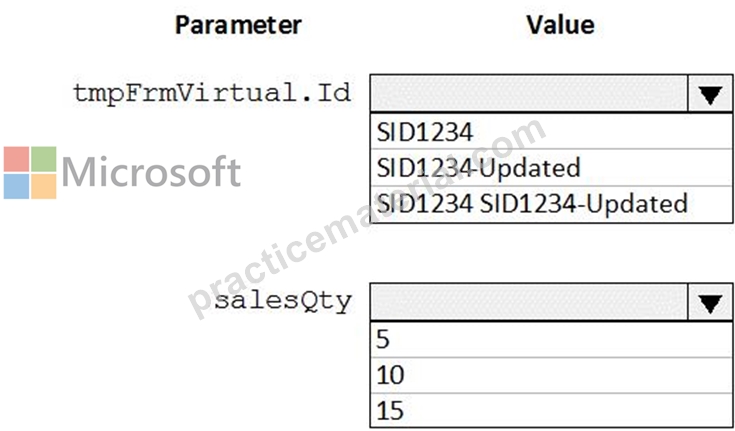
Answer:
Explanation:
Reference:
https://docs.microsoft.com/en-us/dynamics365/fin-ops-core/dev-itpro/dev-ref/xpp-classes-methods
NEW QUESTION 59
Note: This question is part of a series of questions that present the same scenario. Each question in the series contains a unique solution that might meet the stated goals. Some question sets might have more than one correct solution, while others might not have a correct solution.
After you answer a question in this section, you will NOT be able to return to it. As a result, these questions will not appear in the review screen.
You have an enumeration named truckStatus that has the following statuses:
Empty
Loaded
Completed
You have the following code:
You need to extend this enumeration and add the following statuses to the enumeration: Quarantine, InTransit. You must then modify code that validates the switch statement.
Solution: Add a post handler to the method that checks the enumeration and logic for your new enumeration values using a range comparison for your new values.
Does the solution meet the goal?
- A. No
- B. Yes
Answer: A
NEW QUESTION 60
You are a Dynamics 365 Supply chain Management developer. Several users check out a custom form version control and modify the form. You need to find the user that has added a specific line of code to the form. What should you do?
- A. Using Visual Studio, navigate Application Explorer and right-click View History.
- B. In Solution Explorer, navigate to the object and right-click View History.
- C. Open the object in Object Designer, select the title of the object, and then right-click View History.
- D. Using Visual Studio, navigate to the object. Add the object to a new solution, and then right-click View History.
Answer: B
NEW QUESTION 61
You have a Dynamics 365 Finance and Operations environment.
You have the following code: (Line numbers are included for reference only.)
For each of the following statements, select Yes if the statement is true. Otherwise, select No.
NOTE: Each correct selection is worth one point.
Answer:
Explanation: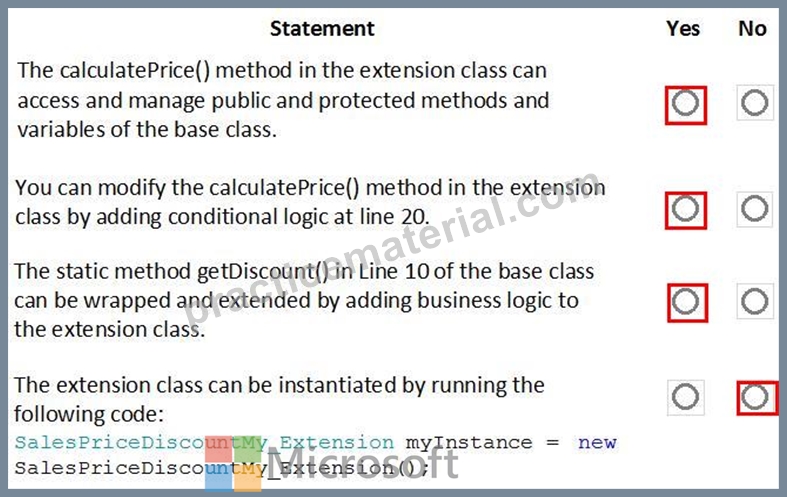
Reference:
https://docs.microsoft.com/en-us/dynamics365/fin-ops-core/dev-itpro/extensibility/method-wrapping-coc
NEW QUESTION 62
You are a Dynamics 365 Finance developer for a company that sells pre-owned vehicles. When the company acquires a new vehicle, vehicle identification (VIN) numbers are added to the VIN field in the CustTable.
You need to create an event handler to validate that new VIN values are at least 10 characters long. Validation must occur when records are saved.
Which three actions should you perform in sequence? To answer, move the appropriate actions from the list of actions to the answer area and arrange them in the correct order.
Answer:
Explanation:
Explanation
Step 1: Copy the validatingWrite event handler on the CustTable object (it is either validatingWrite or validatedWrite, there is no such option as validateWrite).
Step 2: Add the event handler method to a class.
Step 3: Add code to perform the validation.
NEW QUESTION 63
You are a Dynamics 365 Finance developer.
You must extend the validateWrite method of the SalesLine table by using Chain of Command. The value of a variable named SalesPrice must be greater than or equal to zero when adding new lines.
You need to create an extension class.
Which two code segments can you use? Each correct answer presents a complete solution.
NOTE: Each correct selection is worth one point.
- A.

- B.

- C.

- D.

Answer: C,D
Explanation:
Incorrect Answers:
B: Can't use = false in the 4th line.
C: Second line must be start final class, public class
Reference:
https://docs.microsoft.com/en-us/dynamics365/fin-ops-core/dev-itpro/data-entities/validations-defaults- unmapped-fields
https://docs.microsoft.com/en-us/dynamics365/fin-ops-core/dev-itpro/extensibility/method-wrapping-coc
NEW QUESTION 64
You are a Dynamics 365 Finance and Operations developer. You have the following code: (Line numbers are created for reference only.)
Which values does the info() method return? To answer, select the appropriate option in the answer area.
NOTE: Each correct selection is worth one point.
Answer:
Explanation:
Explanation:
Box 1: SID1234
Parameters
All methods have their own scope. A method can take one or more parameters. Within the scope of the method, these parameters are treated as local variables and are initialized with a value from the parameter in the method call. All parameters are passed by value, which means that you can't change the value of the original variable. You can change only the local variable in the method. This local variable is a copy of the original variable.
Box 2: 5
Reference:
https://docs.microsoft.com/en-us/dynamics365/fin-ops-core/dev-itpro/dev-ref/xpp-classes-methods
NEW QUESTION 65
You create a bring your own database (BYOD) entity that includes four tables.
You need to configure change tracking for specific fields in the entity.
Which option should you enable?
- A. entity export
- B. entire entity
- C. primary table
- D. custom query
Answer: D
Explanation:
Reference:
https://docs.microsoft.com/en-us/dynamics365/fin-ops-core/dev-itpro/data-entities/entity-change-track
NEW QUESTION 66
You are a Dynamics 365 Finance developer. You create an integer variable named totalSales.
You need to display the value from totalSales in an info statement.
Which three code segments can you use? Each correct answer presents a complete solution.
NOTE: Each correct selection is worth one point.
- A. Option C
- B. Option E
- C. Option D
- D. Option A
- E. Option B
Answer: A,C,D
Explanation:
A: int2Str converts an integer to the equivalent string.
C: any2Str converts an anytype value to a str value. The anytype data type is a placeholder for any data type.
D: Example:
void MyMethod()
{
for (int i = 0; i < 10; i++)
{
info(strfmt("i is %1", i));
}
}
Reference:
https://docs.microsoft.com/en-us/dynamics365/fin-ops-core/dev-itpro/dev-ref/xpp-variables-data-types
https://docs.microsoft.com/en-us/dynamics365/fin-ops-core/dev-itpro/dev-ref/xpp-data-primitive#anytype
NEW QUESTION 67
You add a field to the SalesTable entity by using an extension.
You need to ensure that the new field is available for use in forms, reports, and code.
What are three possible ways to achieve this goal? Each correct answer presents a complete solution.
NOTE: Each correct selection is worth one point.
- A. Navigate to the Dynamics 365 menu and select Synchronize database.
- B. Right-click the solution and select Synchronize with database.
- C. Set the project property for Synchronize database on build to true and build the solution.
- D. Right-click the table and select Synchronize.
- E. Right-click the project and select Synchronize with database.
Answer: C,D,E
Explanation:
Explanation/Reference:
Develop and Test Code
Question Set 1
NEW QUESTION 68
You need to implement the company's integration requirements.
Which integration strategies should you use? To answer, drag the appropriate integration strategies to the correct requirements. Each integration strategy may be used once, more than once, or not at all. You may need to drag the split bar between panes or scroll to view content.
NOTE: Each correct selection is worth one point.
Answer:
Explanation:
Explanation
Box 1: asynchronous
An asynchronous pattern is a non-blocking pattern, where the caller submits the request and then continues without waiting for a response.
Box 2: Synchronous
A synchronous pattern is a blocking request and response pattern, where the caller is blocked until the callee has finished running and gives a response.
Box 3: Synchronous
Box 4: asynchronous
Batch data is asynchronous.
Reference:
https://docs.microsoft.com/en-us/dynamics365/fin-ops-core/dev-itpro/data-entities/integration-overview#synchro
NEW QUESTION 69
You are training a new Dynamics 365 Finance developer.
You need to recommend where asynchronous integrations should be used instead of synchronous integrations.
For which scenario should you recommend asynchronous integration?
- A. A manufacturer wants to move production data from an on-premises deployment Dynamics 365 Finance in near real-time.
- B. A retailer wants to ensure gift card balances are communicated back to the system from point of sale (POS) terminals in near real-time.
- C. A retailer requires all new customer data captured at point of sale (POS) terminals through the day sent back to the system.
- D. A service company needs workers to be able to access just-in-time inventory data from the field by using a third-party Software as a Service (SaaS) application to ensure they have parts to complete a service.
Answer: C
Explanation:
Classic data integration: Asynchronous
Classic data integration provides asynchronous and uni-directional data synchronization experience between model-driven applications in Dynamics 365 and Dynamics 365 Finance applications. It's an IT-administrator led experience and you must schedule the data sync jobs to run on a specific cadence. Classic data integration is suitable for business scenarios that involves bulk ingress/egress of data across Dynamics 365 applications.
Incorrect Answers:
B: Just-in-time inventory data required.
C: Real-time required.
D: Real-time required.
Note: Dual-write: Synchronous, Bi-directional.
Dual-write provides synchronous, bi-directional, near-real time experience between model-driven applications in Dynamics 365 and Finance applications. Data synchronization happens with little or no intervention and is triggered by create, update and delete actions on an entity. Dual-write is suitable for interactive business scenarios that span across Dynamics 365 applications.
NEW QUESTION 70
Note: This question is part of a series of questions that present the same scenario. Each question in the series contains a unique solution that might meet the stated goals. Some question sets might have more than one correct solution, while others might not have a correct solution.
After you answer a question in this section, you will NOT be able to return to it. As a result, these questions will not appear in the review/ screen.
You create a new form in a project.
You need to display tabs in a vertical alignment.
Solution: Apply the Operational Workspaces pattern.
Does the solution meet the goal?
- A. No
- B. Yes
Answer: B
Explanation:
Reference:
https://docs.microsoft.com/en-us/dynamics365/fin-ops-core/dev-itpro/user-interface/section-tabbed-list-subpatter
NEW QUESTION 71
You are a Dynamics 365 Finance developer.
Users must be able to view a filtered customer list from within a workspace.
You need to add the customer form to a workspace.
Which four actions should you perform in sequence? To answer, move the appropriate actions from the list of actions to the answer area and arrange them on the correct order.
Answer:
Explanation:
Explanation:
Step 1:Open the customer form and apply filters to the grid.
To add a list to a workspace, first sort or filter the list on the page so that it shows the information as you want it to appear in the workspace.
Step 2: Select the General menu item then select Add to workspace
This workspace will be selected in step 3.
Step 3: Select the Options actions pane tab and then select Add to workspace.
For some pages that include lists, the Add to workspace personalization feature is available in the Personalize group on the Options tab of the Action Pane. This feature lets you push relevant information from the current list to a specific workspace.

Step 4: Select Configure
After you select Configure, a dialog box appears, where you can select the columns that should appear in the list in the workspace.
Reference:
https://docs.microsoft.com/en-us/dynamics365/fin-ops-core/fin-ops/get-started/personalize-user-experience
NEW QUESTION 72
You need to update the CashDisc report to meet the requirements.
What should you do?
- A. Duplicate the existing CashDisc report in the extension model and add the new field to the design.
- B. Customize the existing CashDisc report in the overlayering model and add the new field to the design.
- C. Delete the existing CashDisc report in the extension model and create a new report.
- D. Extend the existing CashDisc report in the extension model and add the new field to the design.
Answer: D
Explanation:
Explanation/Reference:
Design and Develop AOT Elements
Question Set 3
NEW QUESTION 73
......
Updated MB-500 Certification Exam Sample Questions: https://www.practicematerial.com/MB-500-exam-materials.html
Get Real Exam Questions for MB-500 with New Questions: https://drive.google.com/open?id=1uilc13sjHnLHXsazXHaxeytr9jpDo_kW
