

Updated Oct-2022 Test Engine to Practice Professional-Machine-Learning-Engineer Dumps & Practice Exam
Dumps Collection Professional-Machine-Learning-Engineer Test Engine Dumps Training With 75 Questions
NEW QUESTION 18
A data scientist uses an Amazon SageMaker notebook instance to conduct data exploration and analysis. This requires certain Python packages that are not natively available on Amazon SageMaker to be installed on the notebook instance.
How can a machine learning specialist ensure that required packages are automatically available on the notebook instance for the data scientist to use?
- A. Create a Jupyter notebook file (.ipynb) with cells containing the package installation commands to execute and place the file under the /etc/init directory of each Amazon SageMaker notebook instance.
- B. Create an Amazon SageMaker lifecycle configuration with package installation commands and assign the lifecycle configuration to the notebook instance.
- C. Use the conda package manager from within the Jupyter notebook console to apply the necessary conda packages to the default kernel of the notebook.
- D. Install AWS Systems Manager Agent on the underlying Amazon EC2 instance and use Systems Manager Automation to execute the package installation commands.
Answer: A
Explanation:
Explanation
Explanation/Reference: https://towardsdatascience.com/automating-aws-sagemaker-notebooks-2dec62bc2c84
NEW QUESTION 19
A financial services company is building a robust serverless data lake on Amazon S3. The data lake should be flexible and meet the following requirements:
* Support querying old and new data on Amazon S3 through Amazon Athena and Amazon Redshift Spectrum.
* Support event-driven ETL pipelines
* Provide a quick and easy way to understand metadata
Which approach meets these requirements?
- A. Use an AWS Glue crawler to crawl S3 data, an Amazon CloudWatch alarm to trigger an AWS Glue ETL job, and an external Apache Hive metastore to search and discover metadata.
- B. Use an AWS Glue crawler to crawl S3 data, an AWS Lambda function to trigger an AWS Glue ETL job, and an AWS Glue Data catalog to search and discover metadata.
- C. Use an AWS Glue crawler to crawl S3 data, an Amazon CloudWatch alarm to trigger an AWS Batch job, and an AWS Glue Data Catalog to search and discover metadata.
- D. Use an AWS Glue crawler to crawl S3 data, an AWS Lambda function to trigger an AWS Batch job, and an external Apache Hive metastore to search and discover metadata.
Answer: B
NEW QUESTION 20
You work for a large technology company that wants to modernize their contact center. You have been asked to develop a solution to classify incoming calls by product so that requests can be more quickly routed to the correct support team. You have already transcribed the calls using the Speech-to-Text API. You want to minimize data preprocessing and development time. How should you build the model?
- A. Use the Cloud Natural Language API to extract custom entities for classification
- B. Use AutoML Natural Language to extract custom entities for classification
- C. Build a custom model to identify the product keywords from the transcribed calls, and then run the keywords through a classification algorithm
- D. Use the Al Platform Training built-in algorithms to create a custom model
Answer: B
NEW QUESTION 21
A machine learning specialist is running an Amazon SageMaker endpoint using the built-in object detection algorithm on a P3 instance for real-time predictions in a company's production application. When evaluating the model's resource utilization, the specialist notices that the model is using only a fraction of the GPU.
Which architecture changes would ensure that provisioned resources are being utilized effectively?
- A. Redeploy the model on an M5 instance. Attach Amazon Elastic Inference to the instance.
- B. Redeploy the model on a P3dn instance.
- C. Redeploy the model as a batch transform job on an M5 instance.
- D. Deploy the model onto an Amazon Elastic Container Service (Amazon ECS) cluster using a P3 instance.
Answer: D
NEW QUESTION 22
You work for a global footwear retailer and need to predict when an item will be out of stock based on historical inventory dat a. Customer behavior is highly dynamic since footwear demand is influenced by many different factors. You want to serve models that are trained on all available data, but track your performance on specific subsets of data before pushing to production. What is the most streamlined and reliable way to perform this validation?
- A. Use k-fold cross-validation as a validation strategy to ensure that your model is ready for production.
- B. Use the last relevant week of data as a validation set to ensure that your model is performing accurately on current data
- C. Use the TFX ModelValidator tools to specify performance metrics for production readiness
- D. Use the entire dataset and treat the area under the receiver operating characteristics curve (AUC ROC) as the main metric.
Answer: C
Explanation:
https://www.tensorflow.org/tfx/guide/evaluator
NEW QUESTION 23
You have a functioning end-to-end ML pipeline that involves tuning the hyperparameters of your ML model using Al Platform, and then using the best-tuned parameters for training. Hypertuning is taking longer than expected and is delaying the downstream processes. You want to speed up the tuning job without significantly compromising its effectiveness. Which actions should you take?
Choose 2 answers
- A. Decrease the range of floating-point values
- B. Decrease the number of parallel trials
- C. Change the search algorithm from Bayesian search to random search.
- D. Decrease the maximum number of trials during subsequent training phases.
- E. Set the early stopping parameter to TRUE
Answer: C,D
NEW QUESTION 24
You need to build classification workflows over several structured datasets currently stored in BigQuery. Because you will be performing the classification several times, you want to complete the following steps without writing code: exploratory data analysis, feature selection, model building, training, and hyperparameter tuning and serving. What should you do?
- A. Use Al Platform Notebooks to run the classification model with pandas library
- B. Use Al Platform to run the classification model job configured for hyperparameter tuning
- C. Configure AutoML Tables to perform the classification task
- D. Run a BigQuery ML task to perform logistic regression for the classification
Answer: A
NEW QUESTION 25
A real estate company wants to create a machine learning model for predicting housing prices based on a historical dataset. The dataset contains 32 features.
Which model will meet the business requirement?
- A. Linear regression
- B. K-means
- C. Logistic regression
- D. Principal component analysis (PCA)
Answer: A
NEW QUESTION 26
A Data Scientist is developing a machine learning model to classify whether a financial transaction is fraudulent. The labeled data available for training consists of 100,000 non-fraudulent observations and 1,000 fraudulent observations.
The Data Scientist applies the XGBoost algorithm to the data, resulting in the following confusion matrix when the trained model is applied to a previously unseen validation dataset. The accuracy of the model is 99.1%, but the Data Scientist has been asked to reduce the number of false negatives.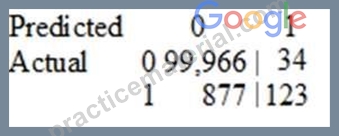
Which combination of steps should the Data Scientist take to reduce the number of false positive predictions by the model? (Choose two.)
- A. Change the XGBoost eval_metric parameter to optimize based on AUC instead of error.
- B. Increase the XGBoost scale_pos_weight parameter to adjust the balance of positive and negative weights.
- C. Change the XGBoost eval_metric parameter to optimize based on rmse instead of error.
- D. Decrease the XGBoost max_depth parameter because the model is currently overfitting the data.
- E. Increase the XGBoost max_depth parameter because the model is currently underfitting the data.
Answer: A,D
NEW QUESTION 27
You are designing an ML recommendation model for shoppers on your company's ecommerce website. You will use Recommendations Al to build, test, and deploy your system. How should you develop recommendations that increase revenue while following best practices?
- A. Import your user events and then your product catalog to make sure you have the highest quality event stream
- B. Because it will take time to collect and record product data, use placeholder values for the product catalog to test the viability of the model.
- C. Use the "Frequently Bought Together' recommendation type to increase the shopping cart size for each order.
- D. Use the "Other Products You May Like" recommendation type to increase the click-through rate
Answer: A
NEW QUESTION 28
A Marketing Manager at a pet insurance company plans to launch a targeted marketing campaign on social media to acquire new customers. Currently, the company has the following data in Amazon Aurora:
* Profiles for all past and existing customers
* Profiles for all past and existing insured pets
* Policy-level information
* Premiums received
* Claims paid
What steps should be taken to implement a machine learning model to identify potential new customers on social media?
- A. Use a decision tree classifier engine on customer profile data to understand key characteristics of consumer segments. Find similar profiles on social media.
- B. Use a recommendation engine on customer profile data to understand key characteristics of consumer segments. Find similar profiles on social media.
- C. Use regression on customer profile data to understand key characteristics of consumer segments. Find similar profiles on social media
- D. Use clustering on customer profile data to understand key characteristics of consumer segments. Find similar profiles on social media
Answer: B
NEW QUESTION 29
You are training a deep learning model for semantic image segmentation with reduced training time. While using a Deep Learning VM Image, you receive the following error: The resource 'projects/deeplearning-platforn/zones/europe-west4-c/acceleratorTypes/nvidia-tesla-k80' was not found. What should you do?
- A. Ensure that the selected GPU has enough GPU memory for the workload.
- B. Ensure that you have GPU quota in the selected region.
- C. Ensure that you have preemptible GPU quota in the selected region.
- D. Ensure that the required GPU is available in the selected region.
Answer: B
NEW QUESTION 30
You developed an ML model with Al Platform, and you want to move it to production. You serve a few thousand queries per second and are experiencing latency issues. Incoming requests are served by a load balancer that distributes them across multiple Kubeflow CPU-only pods running on Google Kubernetes Engine (GKE). Your goal is to improve the serving latency without changing the underlying infrastructure. What should you do?
- A. Recompile TensorFlow Serving using the source to support CPU-specific optimizations Instruct GKE to choose an appropriate baseline minimum CPU platform for serving nodes
- B. Switch to the tensorflow-model-server-universal version of TensorFlow Serving
- C. Significantly increase the max_batch_size TensorFlow Serving parameter
- D. Significantly increase the max_enqueued_batches TensorFlow Serving parameter
Answer: C
NEW QUESTION 31
A monitoring service generates 1 TB of scale metrics record data every minute. A Research team performs queries on this data using Amazon Athena. The queries run slowly due to the large volume of data, and the team requires better performance.
How should the records be stored in Amazon S3 to improve query performance?
- A. CSV files
- B. RecordIO
- C. Parquet files
- D. Compressed JSON
Answer: C
NEW QUESTION 32
You work with a data engineering team that has developed a pipeline to clean your dataset and save it in a Cloud Storage bucket. You have created an ML model and want to use the data to refresh your model as soon as new data is available. As part of your CI/CD workflow, you want to automatically run a Kubeflow Pipelines training job on Google Kubernetes Engine (GKE). How should you architect this workflow?
- A. Use App Engine to create a lightweight python client that continuously polls Cloud Storage for new files As soon as a file arrives, initiate the training job
- B. Configure a Cloud Storage trigger to send a message to a Pub/Sub topic when a new file is available in a storage bucket. Use a Pub/Sub-triggered Cloud Function to start the training job on a GKE cluster
- C. Configure your pipeline with Dataflow, which saves the files in Cloud Storage After the file is saved, start the training job on a GKE cluster
- D. Use Cloud Scheduler to schedule jobs at a regular interval. For the first step of the job. check the timestamp of objects in your Cloud Storage bucket If there are no new files since the last run, abort the job.
Answer: C
NEW QUESTION 33
Your team has been tasked with creating an ML solution in Google Cloud to classify support requests for one of your platforms. You analyzed the requirements and decided to use TensorFlow to build the classifier so that you have full control of the model's code, serving, and deployment. You will use Kubeflow pipelines for the ML platform. To save time, you want to build on existing resources and use managed services instead of building a completely new model. How should you build the classifier?
- A. Use an established text classification model on Al Platform as-is to classify support requests
- B. Use AutoML Natural Language to build the support requests classifier
- C. Use an established text classification model on Al Platform to perform transfer learning
- D. Use the Natural Language API to classify support requests
Answer: A
NEW QUESTION 34
You are training an LSTM-based model on Al Platform to summarize text using the following job submission script: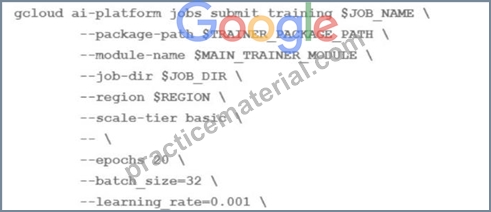
You want to ensure that training time is minimized without significantly compromising the accuracy of your model. What should you do?
- A. Modify the 'scale-tier' parameter
- B. Modify the batch size' parameter
- C. Modify the 'epochs' parameter
- D. Modify the 'learning rate' parameter
Answer: B
NEW QUESTION 35
......
Google Professional-Machine-Learning-Engineer Dumps Cover Real Exam Questions: https://www.practicematerial.com/Professional-Machine-Learning-Engineer-exam-materials.html
Real Professional-Machine-Learning-Engineer dumps - Real Google dumps PDF: https://drive.google.com/open?id=1Fi9J8X5ncUVPuhZyp-akMFOfyqitNiOi
