

[Apr-2024] UiPath-ADPv1 Dumps PDF - UiPath-ADPv1 Real Exam Questions Answers
UiPath-ADPv1 Dumps 100% Pass Guarantee With Latest Demo
NEW QUESTION # 103
Considering that the attached table is stored in a variable called "dt":
Which LINQ query can be used to return the maximum total Quantity?
- A. dt.AsEnumerable. Max(Function(x) Convert.ToInt32(x("Quantity").ToString))("Item")
- B. dt.AsEnumerable. OrderByDescending(Function(x) Convert.ToInt32(x("Quantity").ToString)). First.Item("Quantity")
- C. dt.AsEnumerable. GroupBy(Function(x) x("Item").ToString). Max(Function(x) x.Sum(Function(y) Convert.ToInt32(y("Quantity").ToString)))
- D. dt.AsEnumerable. Max(Function(x) Convert.ToInt32(x("Quantity").ToString))
Answer: C
NEW QUESTION # 104
What is the use of job priorities in unattended automations within UiPath Orchestrator?
- A. To determine machine resource allocation among processes.
- B. To determine which processes should be executed first when dealing with multiple jobs.
- C. To sort and organize tasks within a folder.
- D. To create job dependencies that must be completed before new job execution.
Answer: B
Explanation:
The use of job priorities in unattended automations within UiPath Orchestrator is to determine which processes should be executed first when dealing with multiple jobs. Job priorities are values that can be assigned to jobs or triggers when they are created or edited. The possible values are High, Normal, and Low. Job priorities affect the order in which the jobs are executed by the robots, with higher priority jobs being executed before lower priority jobs. Job priorities can help you to optimize the execution of your unattended automations, especially when you have limited resources or time-sensitive processes. You can also use job priorities to create job dependencies that must be completed before new job execution, by using the Start Job activity with the Wait for completion option and setting the priority of the child job to High. References: [Job Priority],
[Start Job]
NEW QUESTION # 105
What is the purpose of the Interval filter in the Orchestrator's Monitoring page?
- A. It allows you to control the granularity of the displayed data and check the health of your system in either the last day or the last hour.
- B. It allows you to choose between background and foreground processes for the displayed data.
- C. It allows you to allocate licenses per machine for the displayed data.
- D. It enables you to sort the displayed data based on job priorities.
Answer: A
NEW QUESTION # 106
How should the computation of the signature be done for client apps that receive Orchestrator requests and need to check their authenticity?
Instructions: Drag the Description found on the left and drop on the correct Step Sequence found on the right.
Answer:
Explanation: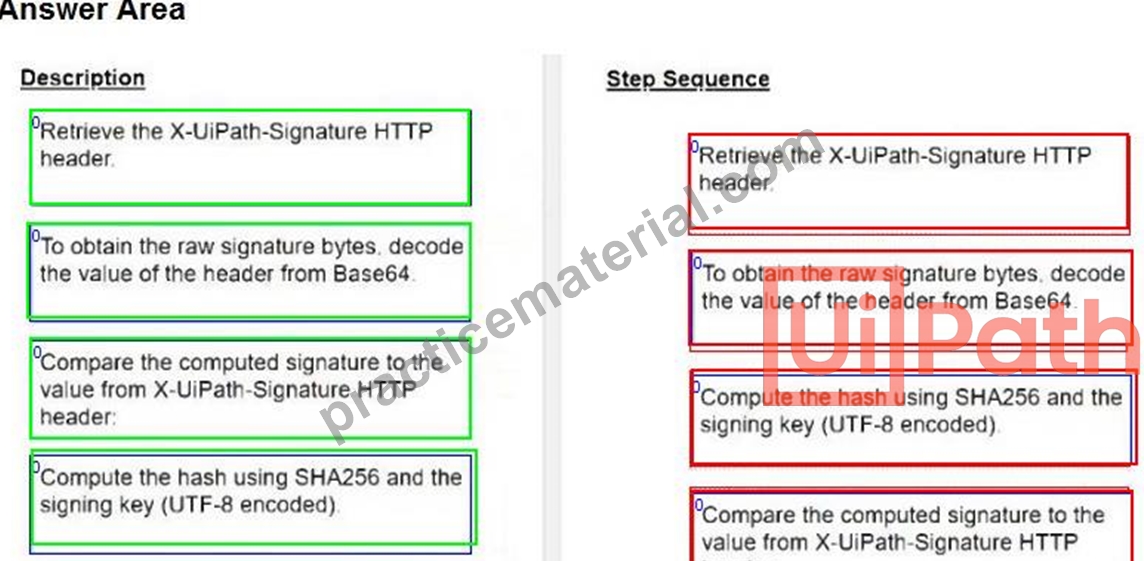
NEW QUESTION # 107
A developer configured the properties for a Click activity as shown below:
What happens if the activity cannot find its target at runtime?
- A. An exception is thrown after 10 seconds.
- B. The next activity is executed after 10 seconds.
- C. An exception is thrown after 10 milliseconds.
- D. The next activity is executed after 10 milliseconds.
Answer: A
Explanation:
The Click activity has a property called TimeoutMS. This property specifies the amount of time (in milliseconds) to wait for the activity to be executed before an error is thrown. In this case, the TimeoutMS property is set to 10000 milliseconds (10 seconds). Therefore, if the activity cannot find its target at runtime, an exception will be thrown after 10 seconds.
NEW QUESTION # 108
What can be verified in the InltAIISettlngsTestCase test case?
- A. Verify If a certain key is present in the 'Config' dictionary.
- B. Verify the variable type for the 'Config' dictionary.
- C. Verify If a certain application is open in the execution environment.
- D. Verify the naming of a certain key present in the 'Config' dictionary.
Answer: A
Explanation:
In the InitAllSettingsTestCase test case, one of the verifications that can be done is to check if a certain key is present in the 'Config' dictionary. This ensures that necessary configurations are available for the process.
NEW QUESTION # 109
Starting with UiPath Studio version 2022.10, what happens to dependencies that lack Windows compatibility when they are converted in a project?
- A. They are marked as unresolved.
- B. They are removed from the project.
- C. They are automatically resolved.
- D. They are replaced with compatible alternatives.
Answer: A
NEW QUESTION # 110
Which activity should a developer use to add custom information to logs related to transactions for tracing purposes?
- A. Build Log
- B. Update Logs
- C. Add Log Fields
- D. Add Custom Log
Answer: C
Explanation:
The Add Log Fields activity enables you to add custom information to logs related to transactions for tracing purposes1. The activity takes a collection of string arguments as input, which are added to every subsequent log message throughout the entire workflow, unless a Remove Log Fields activity is used1. The custom log fields can be useful for adding more information and visibility to the logs, especially for transactional data processes2. For example, you can use the Add Log Fields activity to add the transaction ID, the transaction status, the business process name, or any other relevant data to the logs2. Therefore, the correct answer is A.
Add Log Fields.
NEW QUESTION # 111
A developer creates a process that uses data from multiple sources and uploads it to an Orchestrator queue. The data originates from emails in different email inboxes and needs to be processed in the same order in which the email was received. To ensure the Queue Items are processed in the correct order, which property of the Add Queue Item activity should be used?
- A. Reference
- B. Deadline
- C. Itemlnformation
- D. Postpone
Answer: D
NEW QUESTION # 112
In a UiPath project that uses State Machines, under what circumstances should the Final State activity be used in the project?
- A. When initiating the first state of a state machine.
- B. When a particular state contains complex conditional logic.
- C. When an intermediary state has multiple possible transitions.
- D. When marking the successful completion or termination of a state machine's execution.
Answer: D
Explanation:
A state machine is a type of automation that uses a finite number of states in its execution. It can go into a state when it is triggered by an activity, and it exits that state when another activity is triggered. Another important aspect of state machines are transitions, as they also enable you to add conditions based on which to jump from one state to another. These are represented by arrows or branches between states.
The Final State activity is a state machine specific activity that ends a state machine cycle. This activity contains an Entry area which holds the activities that are to be performed when the state is entered. A state machine must have one initial state and one or more final states.
The Final State activity should be used in the project when marking the successful completion or termination of a state machine's execution. This means that the automation has reached its desired outcome or encountered an unrecoverable error, and no further actions are required. The Final State activity can also be used to perform some cleanup or logging activities before ending the state machine.
The other options are not circumstances when the Final State activity should be used in the project. Option A is incorrect, because an intermediary state can have multiple possible transitions, but it does not end the state machine cycle. Option B is incorrect, because a particular state can contain complex conditional logic, but it does not end the state machine cycle. Option C is incorrect, because the initial state is the first state of a state machine, not the final state.
References: Activities - Final State - UiPath Documentation Portal, Studio - State Machines - UiPath Documentation Portal, [State Machine Activity Designer - Microsoft Docs]
NEW QUESTION # 113
A developer needs to use the REFramework in order to implement a linear process. Which value should be set to "out_Transactionltem" the first time when it enters the Get Transaction Data state?
- A. It should be set to the next queue item in order to be, further on, processed.
- B. It can be set to a static value and. in order to respect the UiPath best practices, this value should be taken from "Config.xlsx".
- C. It should be set to Nothing because a linear process should not enter the second time in the Get Transaction Data state.
- D. The process will not enter the Get Transaction Data state because a linear process is not transactional.
Answer: C
Explanation:
The out_TransactionItem argument is an output argument of the GetTransactionData workflow, which is used to store the data of the current transaction item1. The REFramework is a template for creating robust and scalable automation projects that uses the State Machine workflow type2. The REFramework is designed for transactional processes, which are processes that handle multiple items of data in a loop3. However, it can also be adapted for linear processes, which are processes that execute a sequence of actions only once.
To use the REFramework for a linear process, the out_TransactionItem argument should be set to Nothing the first time when it enters the Get Transaction Data state. This will ensure that the process will not enter the Get Transaction Data state again, as the condition for the transition from the Get Transaction Data state to the Process Transaction state is out_TransactionItem isNot Nothing1. Setting the out_TransactionItem argument to Nothing will also trigger the End Process state, which will perform the final actions and close the application1.
Option A is incorrect, because the process will enter the Get Transaction Data state even if it is a linear process, as it is the first state in the REFramework. Option B is incorrect, because there is no queue item in a linear process, as there is only one item of data to be processed. Option D is incorrect, because setting the out_TransactionItem argument to a static value will cause the process to enter the Get Transaction Data state repeatedly, as the condition for the transition will always be true.
References: 1: The UiPath ReFramework 2: State Machine 3: Transactional Business Process : [Linear Business Process]
NEW QUESTION # 114
Which of the following describes the correct hierarchy of the elements in the Object Repository tree structure?
- A. Screen, Application, Version, Ul Element.
- B. Version, Application, Screen, Ul Element.
- C. Application, Version, Screen, Ul Element.
- D. Application, Screen, Ul Element, Version.
Answer: D
Explanation:
The Object Repository in UiPath organizes elements in a hierarchical structure that reflects the logical arrangement of user interfaces and elements as they are captured and used in automation projects.
The correct hierarchy for elements in the Object Repository tree structure is:
A: Version, Application, Screen, UI Element.
This hierarchy starts with the 'Version', which could refer to the specific version of the application you are automating. Under each version, there could be multiple 'Applications' that you have elements for. Within each application, you might have captured various 'Screens' or dialogs, and within each screen, there are individual
'UI Elements' like buttons, text fields, dropdown menus, etc., that the automation interacts with.
However, it's important to note that in practice, when you are working with UiPath Studio and its Object Repository, the hierarchy usually starts with the 'Application', then under it, you have different 'Screens' of the application, and under each screen, you have the 'UI Elements'. The 'Version' is typically managed separately and is not a level in the hierarchy tree but rather a property or attribute of the application or element.
Therefore, the most practical answer reflecting the usage in UiPath Studio would be:
C: Application, Screen, UI Element, Version.
The 'Version' here would be understood not as a layer in the hierarchy but rather as an attribute that can be associated with the 'Application' or 'UI Element'.
NEW QUESTION # 115
What is the purpose of credential stores in UiPath Orchestrator?
- A. To serve as a centralized location for storing pre-built automation workflows and processes.
- B. To store Orchestrator event loos and related data for auditing purposes.
- C. To store non-sensitive data and configuration settings for UiPath Studio projects.
- D. To securely store sensitive data such as Robot credentials and Credential Assets for use in automation processes.
Answer: D
NEW QUESTION # 116
When should the Show Elements button be used in the Computer Vision wizard?
- A. Filtering out specific Ul elements from being processed by the Computer Vision engine.
- B. Activating a real-time view of the target agp^s Ul during automation.
- C. Displaying a list of all available Ul elements and their properties.
- D. Highlighting all Ul elements that have been identified by the Computer Vision analysis.
Answer: D
Explanation:
The Show Elements button in the Computer Vision wizard is used to highlight all UI elements that have been identified by the Computer Vision analysis. This helps you to see the UI elements that are available for automation and to select the ones that you want to use in your activities. The Show Elements button is located in the top-right corner of the Computer Vision wizard. When you click it, the UI elements are highlighted with different colors and shapes, depending on their type and category. You can hover over each UI element to see its name and properties. You can also use the Filter Elements button to filter out specific UI elements from being processed by the Computer Vision engine.
NEW QUESTION # 117
Which Scraping method should be used for the Get Text activity to capture hidden text from an application?
- A. Text attribute
- B. Full text
- C. Native
- D. Default
Answer: B
Explanation:
The Get Text activity in UiPath Studio is used to extract and copy the text from a UI element. It has a property called Scraping method, which allows you to choose the method of scraping text from the target element. The available methods are Default, Text attribute, Full text, and Native.
The Default method tries all the other methods and chooses the best one automatically. The Text attribute method uses the text value of the target element as the output. The Native method uses the native method of the application to scrape the text, and allows formatting and screen coordinates to be retrieved. The Full text method uses an OCR engine to scrape the text, and offers the option to Ignore hidden text, which can be activated by selecting its respective check box.
To capture hidden text from an application, the Full text method with the Ignore hidden text option enabled should be used. This way, the Get Text activity can retrieve the text that is not visible on the screen, but is present in the UI element. For example, this method can be used to get the text from a combo box that has more items than the ones displayed, or from a terminal window that has more editable text than the ones shown.
References: Activities - Get Text - UiPath Documentation Portal, Get Text or Get Full Text for Hidden Text - Studio - UiPath Community Forum, How to: Scrape the Whole Text, Including Hidden Elements from ... - UiPath
NEW QUESTION # 118
The following table is stored in a variable called "dt".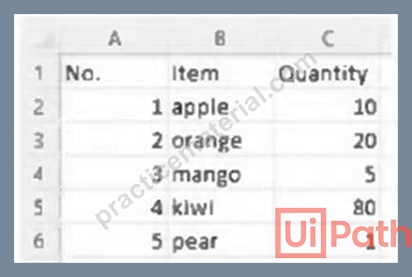
What will the value of the qty variable be after executing the Assign activity?
- A. 0
- B. null
- C. 1
- D. 2
Answer: D
NEW QUESTION # 119
......
Dumps Real UiPath UiPath-ADPv1 Exam Questions [Updated 2024]: https://www.practicematerial.com/UiPath-ADPv1-exam-materials.html
Prepare UiPath-ADPv1 Question Answers Free Update With 100% Exam Passing Guarantee [2024]: https://drive.google.com/open?id=18CsvbrVhMyjTNodHnQlFxC5eerLK8qIa
