

VMware 5V0-41.20 Daily Practice Exam New 2022 Updated 36 Questions
Use Valid 5V0-41.20 Exam - Actual Exam Question & Answer
VMware 5V0-41.20: VMware vSAN 6.7 Specialist Certification Path
5V0-41.20 practice exam is for foundation level Certification. As such, there is no prerequisite for this course. Anyone who has a keen interest and is familiar with VmWare technology is well invited to pursue this certification.
Topics of VMware 5V0-41.20: VMware vSAN 6.7 Specialist Exam
Candidates must know the exam topics before they start preparation. Because it will really help them to hit the core. Our 5V0-41.20 dumps will include the following topics:
1. vSAN Architectures and Technologies
- Describe vSAN requirements
- Demonstrate how vSAN stores and protects data
- Define vSAN space efficiency features
- Compare the architectural requirements of a vSAN 2-node cluster and a stretched cluster
- Define vSAN stretched cluster architecture requirements
2. Products and Solutions
3. Planning and Designing
- Define which VMware solutions integrate with vSAN
- Explain interoperability with vSphere features
- Use vSAN design and sizing tools
- Define and demonstrate vSAN design considerations
- Design a vSAN cluster
4. vSAN Installation, Configuration, and Setup
- Objective 4.2 â Create and manage disk groups
- Objective 4.4 â Configure vSAN stretched cluster and 2-node configurations
- Objective 4.3 â Configure and validate vSAN services
- Configure and validate a vSAN configuration
5. Performance-tuning, Optimization, and Upgrades
6. Troubleshooting and Repairing a vSAN solution
- Manage hardware replacement
- Interpret vSAN Health warnings
- Evaluate performance information in the UI and using CLI
- Identify failure scenarios
- Determine vSAN Health using vSphere Host Client, ESXCLI, and RVC
7. vSAN Administrative and Operational Tasks
- Interpret vSAN capacity terms
- Patch or upgrade a vSAN cluster
- Describe effects of maintenance mode options
- Describe vSAN data placement changes
- Evaluate vSAN performance metrics
- Explain how to add capacity to a vSAN cluster
- Explain encryption processes
- Describe the operational characteristics/differences between vSAN 2-node architecture and stretched cluster
- Create, update, and modify vSAN policies and apply them to objects
- Explain how to utilize TRIM and UNMAP from vSAN and guest perspective
NEW QUESTION 16
Scenario 3:
After completing the branch activation activities for all required branches, the network administrator attempts to test connectivity between the various branches and between the hubs and branches. The administrator notices a lack of connectivity despite being certain that configurations have been complete. The administrator also observed that several users are reporting intermittent connectivity to some of the applications they are accessing. Other users are reporting no access to these applications. Other users at some of the branches claim they cannot get to certain public resources. The administrator wants to ensure that all sites can talk to each other and all resources are accessible.
Exhibit.
The network administrator determines that dynamic routes to SD-WAN sites are missing at the San Jose branch router. The network administrator decides to look into the configurations of hub Edges. All SD-WAN branch sites must use a hub to communicate with the San Jose site. Best practices have been implemented at these SD-WAN sites.
Where should the administrator check first to verify if the configuration is correct?
- A. Verify that the NVS feature is enabled in Cloud VPN.
- B. Verify that redistribution between the primary hub site and San Jose is enabled.
- C. Verify the static routes to San Jose from all Branches are configured.
- D. Verify that redistribution at the Dallas Hybrid Site is enabled for San Jose to use as a peering point.
Answer: C
NEW QUESTION 17
Scenario 3:
After resolving numerous connectivity issues throughout the various branch sites, connectivity between applications and users is finally present. The network administrator is informed that during certain tests, applications are not performing as they are expected to. Users report that call quality has not fully improved and that some of their calls either drop or have poor voice quality where the conversation is breaking up. Other users are noticing that file transfers are slower than expect. A group of users from a few sites have reported slowness in accessing; internal and external applications.
Exhibit.
A network administrator is configuring several branches to prefer a single prefix, 10.20.11.0/24, from the Seattle hub over the New York hub for various application performance reasons.
What are two effective ways the administrator can accomplish this? (Choose two.)
- A. In the hub preferred order in the profile, set the Seattle hub to be preferred over New York.
- B. Modify the AS Path in New York to be longer for 10.20.11.0/24.
- C. Modify the AS Path in New York to be shorter for 10.20.11.0/24.
- D. In the OFC 10.20.11.0/24, modify the preferred exit point to be Seattle and pin the route.
Answer: A,D
NEW QUESTION 18
Scenario 3:
After resolving numerous connectivity issues throughout the various branch sites, connectivity between applications and users is finally present. The network administrator is informed that during certain tests, applications are not performing as they are expected to. Users report that call quality has not fully improved and that some of their calls either drop or have poor voice quality where the conversation is breaking up. Other users are noticing that file transfers are slower than expect. A group of users from a few sites have reported slowness in accessing internal and external applications.
Exhibit.
A network administrator is receiving complaints that a real-time voice application is not performing well, with choppy audio, and dead audio especially during peak traffic times.
What two actions can the administrator take to diagnose and fix the issue? (Choose two.)
- A. Check the status of the links using the QoE and Transport tabs for any degraded underlay issues or congestion issues.
- B. Configure a QoS policy to load balance the realtime traffic across all links.
- C. Configure a QoS policy to rate limit all traffic during peak times.
- D. Ensure that the realtime application is matching the correct application type using the diagnostics page.
Answer: A,C
NEW QUESTION 19
Scenario 3:
After resolving numerous connectivity Issues throughout the various branch sites, connectivity between applications and users is finally present. The network administrator is informed that during certain tests, applications are not performing as they are expected to. Users report that call quality has not fully improved and that some of their calls either drop or have poor voice quality where the conversation is breaking up. Other users are noticing that file transfers are slower than expect. A group of users from a few sites have reported slowness in accessing internal and external applications.
Exhibit.
Users at a remote office are complaining about poor performance with certain applications. The network administrator has already verified the configuration is correct.
Which two parameters should the administrator review to troubleshoot this issue? (Choose two.)
- A. Look under Monitor, check Business priority tab
- B. Check the flows to verify which Business Policy the traffic of interest is matching
- C. Check the underlay network (bandwidth, latency, jitter, packet loss)
- D. Change the bandwidth measurement under WAN Overlay Advanced Settings
Answer: A,C
NEW QUESTION 20
Scenario 3:
After resolving numerous connectivity issues throughout the various branch sites, connectivity between applications and users is finally present. The network administrator is informed thatduring certain tests, applications are not performing as they are expected to. Users report that call quality has not fully improved and that some of their calls either drop or have poor voice quality where the conversation is breaking up. Other users are noticing that file transfers are slower than expect. A group of users from a few sites have reported slowness in accessing internal and external applications.
Exhibit.
Users at the Dallas Branch are complaining that downloads/uploads from Office365 are slow. Working in Teams has been providing slow responses. The Internet circuit is 100Mbps while the MPLS Circuit is
45Mbps. Upon troubleshooting, the network administrator has noticed the traffic is Backhauling through the Seattle hub for all internet traffic.
How should the network administrator resolve the issue?
- A. Leave the system as is, the gateways will resolve the issues after doing 15 minutes of link qualification.
- B. Prevent the hub from advertising a default route.
- C. Advertise public routes to Office365 and Teams through the New York Hub.
- D. Leave the system as is, the hubs will auto-rebalance tunnels after doing 15 minutes of link qualification.
Answer: C
NEW QUESTION 21
Scenario 2:
After completing the branch activation activities for all required branches, the network administrator attempts to test connectivity between the various branches and between the hubs and branches. The administrator notices a lack of connectivity despite being certain that configurations have been complete. The administrator also observed that several users are reporting intermittent connectivity to some of the applications they are accessing. Other users are reporting no access to these applications. Other users at some of the branches claim they cannot get to certain public resources. The administrator wants to ensure that all sites can talk to each other and all resources are accessible.
Exhibit.
A network administrator decides to deploy a local Checkpoint VNF appliance on the Edge in London to cut back on unnecessary traffic towards the NY Hub location. While attempting to deploy the VNF, the process keeps failing.
Where can the administrator check to see more detail?
- A. VCO > Monitor > Logging
- B. VCO > Test & Troubleshoot > Remote Diagnostics > Events
- C. VCO > Test & Troubleshoot > Remote Actions > Alerts
- D. VCO > Monitor > Events
Answer: A
NEW QUESTION 22
Scenario 2:
After completing the branch activation activities for all required branches, the network administrator attempts to test connectivity between the various branches and between the hubs and branches. The administrator notices a lack of connectivity despite being certain that configurations have been complete. The administrator also observed that several users are reporting intermittent connectivity to some of the applications they are accessing. Other users are reporting no access to these applications. Other users at some of the branches claim they cannot get to certain public resources. The administrator wants to ensure that all sites can talk to each other and all resources are accessible.
Exhibit.
Several reports have come in from branch locations indicating customers cannot reach applications being served by the hub location. The hub location has a single LAN-side port from which it should be learning dynamic routes for the subnets serving the applications.
How should the technician verify if the ports on the Edge are up and working?
- A. Look under Administration and System Settings to verify if the interfaces are configured and enabled.
- B. Look in Test&Troubleshoot under the Remote Diagnostics and run Interface status.
- C. Look in Test&Troubleshoot under the Remote Actions and run System Health.
- D. Look in Test&Troubleshoot under the Remote Diagnostics and run System Health.
Answer: A
NEW QUESTION 23
Scenario:1
A network administrator is tasked with enabling SD-WAN at three branch locations, A topology has been provided for reference. For each site, the administrator is having issues bringing edges online, as another administrator has gone ahead and created a configuration ahead of time. The organization has several branch sites. One is an Internet-only site and two are Hybrid locations with both internet and MPLS. The last location is MPLS only. There are hub data center in this environment as well. Please refer to the topology.
Exhibit.
One of the Edges at the Chicago site is unable to activate. The Edge has a red LED. What is the next troubleshooting step?
- A. If the Edge is connected to the MPLS circuit, determine if the Hub is advertising gateway routes.
- B. If the Edge is connected to the MPLS circuit which does not have DHCP, determine if there is a static IP configuration that needs to be applied upon activation.
- C. If the Edge is connected to its HA peer, determine if underlay BGP peering is present between the two Edges.
- D. If the Edge is connected to its HA peer, determine if there is a link-light on the HA peer-link.
Answer: A
NEW QUESTION 24
Scenario 2:
After completing the branch activation activities for all required branches, the administrator attempts to test connectivity between the various branches and between the hubs and branches- The administrator notices a lack of connectivity despite being certain that configurations have been complete. The administrator also observed that several users are reporting intermittent connectivity to some of the applications they are accessing. Other users are reporting no access to these applications. Other users at some of the branches claim they cannot get to certain public resources. The administrator wants to ensure that all sites can talk to each other and all resources are accessible.
Exhibit.
The tunnel from the Dallas site to the Seattle hub is not coming up.
What are two things that should be checked to determine the issue? (Choose two.)
- A. Dynamic Branch to Branch is not enabled.
- B. Hub WAN Interface might be behind a firewall.
- C. Spoke Edge and Hub Edge are two different Edge models.
- D. Spoke Edge and Hub Edge have a mismatched certificate.
Answer: C,D
NEW QUESTION 25
Scenario 1:
A network administrator is tasked with enabling SD-WAN at three branch locations. A topology has been provided for reference. For each site, the administrator is having issues bringing edges online, as another administrator has gone ahead and created a configuration ahead of time. The organization has several branch sites. One is an Internet-only site and two are Hybrid locations with both internet and MPLS. The last location is MPLS only. There are hub data center locations in this environment as well. Please refer to the topology.
Exhibit.

The network administrator determines the issue preventing the Dallas Branch from coming online.
Refer to the Exhibit(s).
What must the administrator do for the Edge to communicate with the Orchestrator and other branches?
- A. Create a User-defined WAN Overlay to bond both interfaces
- B. Reverse the WAN Overlay configurations
- C. Delete the User Defined WAN Overlays as the Orchestrator will discover these automatically on MPLS and Internet
- D. Update the Orchestrator to the latest version as it enables "Auto WAN Swapping"
Answer: C
NEW QUESTION 26
Scenario 1:
A network administrator is tasked! with enabling SO-WAN at three branch locations. A topology has been provided for reference. For each site, the administrator is having issues bringing edges online, as another administrator has gone ahead and created a configuration ahead of time. The organization has several branch sites- One is an Internet-only site and two are Hybrid locations with both internet and MPLS: The last location is MPLS only. There are hub data center locations in this environment as well. Please refer to the topology.
Exhibit.
An administrator is attempting to activate two Edge devices at the Chicago branch location. The local technician reports that the Edge devices are not coming online. The Edge devices have been plugged in, powered on, and connected to the correct circuits with an Enhanced HA setup.
What should the local technician check first when troubleshooting the issue?
- A. Review color of the LED.
- B. Verify the link light sequence of the HA ports.
- C. Review the Orchestrator for HA misconfiguration issues.
- D. Verify beep sequence of the Edge devices.
Answer: B
NEW QUESTION 27
Scenario 1:
The Dallas Branch location is having issues getting activated. The local network administrator is aware that the Edge device received a DHCP address and was able to connect to the internet. The Orchestrator is reporting the Edge as Down. No other changes were made post activation.
A network administrator is tasked with enabling SD-WAN at three branch locations. A topology has been provided for reference. For each site, the administrator is having issues bringing edges online, as another administrator has gone ahead and created a configuration ahead of time. The organization has several branch sites. One is am Internet-only site and two are Hybrid locations with both internet and MPLS. The last location is MPLS only. There are hub data center locations in this environment as well. Please refer to the topology.
Refer to the Exhibit(s).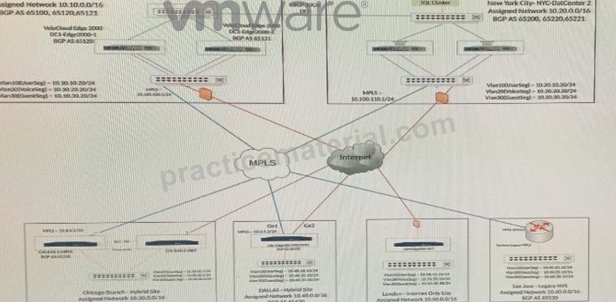

What is the cause of this issue?
- A. The Edge will be offline for about 4 hours until it has completed the factory image installation.
- B. The activation link contained incorrect configurations for WAN overlays and WAN interfaces.
- C. The activation link did not contain any post-activation configuration to allow the Orchestrator to communicate with the Edge.
- D. The activation link did not specify the updated image location requiring the Edge to be re-activated.
Answer: D
NEW QUESTION 28
Scenario 3:
After resolving numerous connectivity issues throughout the various branch sites, connectivity between applications and users is finally present. The network administrator is informed that during certain tests, applications are not performing as they are expected to. Users report that call quality has not fully improved and that some of their calls either drop or have poor voice quality where the conversation is breaking up. Other users are noticing that file transfers are slower than expect. A group of users from a few sites have reported slowness in accessing internal and external applications.
Exhibit.
A network administrator decides to deploy a local Checkpoint VNF appliance on the Edge in London to cut back on unnecessary traffic towards the NY hub location.
The Checkpoint VNF and associated security services were successfully deployed at the London Branch.
Users are now are complaining that Webpages are extremely slow to load, just like before.
What should the administrator do?
- A. Disable and redeploy the VNF with lower memory requirements.
- B. Verify to see if a firewall rule in the Edge is set to allow traffic to the Checkpoint VNF.
- C. Reboot the Edge, as this is a requirement in the deployment of a Security VNF.
- D. Check the flow records in Remote Diagnostics.
Answer: A
NEW QUESTION 29
Scenario 3:
After resolving numerous connectivity issues throughout the various branch sites, connectivity between applications and users is finally present. The network administrator is informed that during certain tests, applications are not performing as they are expected to. Users report that callquality has not fully improved and that some of their calls either drop or have poor voice quality where the conversation is breaking up. Other users are noticing that file transfers are slower than expect. A group of users from a few sites have reported slowness in accessing internal and external applications.
Users at multiple branches complain that a highly performant SQL Database cluster residing at the New York Data Center is not responding to database queries or inserts as expected. It is affecting the order management site. A network administrator investigates and finds that traffic from the branches are going through Seattle to reach the SQL Cluster in New York. The design for this SD-WAN network does not call for routing security.
The SQL Cluster is reachable through either Data Center, but for performance reasons, must flow through the New York DC. The network administrator has verified that the routes are not present in the OFC and the BGP neighborship is down in Network Services.
Refer to the Exhibit(s).
Exhibit.

What should the administrator verify?
- A. The BGP Authentication matches on both sides.
- B. The BGP configuration has a filter in place to deny the prefix in Seattle.
- C. Backhauling through the Seattle DC is disabled.
- D. The BGP configuration has a filter in place to deny the prefix in New York.
Answer: C
NEW QUESTION 30
......
Test Engine to Practice 5V0-41.20 Test Questions: https://www.practicematerial.com/5V0-41.20-exam-materials.html
